As the saying goes, “It ain’t what you don’t know that gets you into trouble. It’s what you know for sure that just ain’t so.” When it comes to cosmetics and personal care products, that problem is everywhere. Many people assume these products are tightly regulated, thoroughly screened, and transparently labeled before they ever reach store shelves. The reality is more complicated.
Published: Jun 2019
Last Updated: Apr 2026
Below are some of the most common myths about cosmetic safety, along with the reality consumers should understand before assuming a product is harmless simply because it is widely sold.
Myth: If It’s Sold in Stores, It Must Be Safe
Reality: In the United States, cosmetic products and ingredients generally do not require FDA premarket approval, with the exception of color additives.1,2 That means most products reach the market without the kind of pre-sale review many consumers assume is taking place. Companies are legally responsible for ensuring safety, but that is not the same thing as independent pre-approval by the government.1
Myth: The Government Prohibits Dangerous Cosmetic Ingredients
Reality: Cosmetic regulation varies widely by jurisdiction. The European Union’s cosmetics framework is broader and more restrictive in important ways than the U.S. system, while the FDA maintains a comparatively limited set of explicit prohibitions and restrictions for cosmetics.3,4 “Allowed” does not automatically mean an ingredient is ideal for every person or every type of repeated exposure.
Myth: The Cosmetics Industry Strictly Polices Itself
Reality: The cosmetics industry does have review mechanisms, such as the Cosmetic Ingredient Review (CIR) program, but these assessments are not the same as binding FDA approval decisions.5 CIR reviews can be informative, but companies still retain substantial discretion over formulation choices, and regulatory enforcement remains separate from industry review.1,5
Myth: Cosmetic Ingredients Just Sit on the Skin
Reality: Exposure from cosmetics can happen through more than one route. Depending on the product, ingredients may be inhaled, incidentally ingested, or absorbed through the skin.6,7 Biomonitoring and exposure studies have repeatedly detected personal-care-related chemicals in human samples, showing that real-world exposure does occur.6,8 The extent and health significance vary by ingredient, product type, and frequency of use, but the old idea that topical products simply remain on the surface is too simplistic.
Myth: If an Ingredient Is on the Label, You Know the Whole Formula
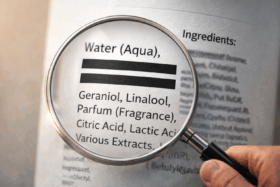
Reality: Ingredient labels are essential, but they do not always tell the entire story. U.S. law allows certain fragrance and flavor mixtures to be protected as trade secrets, meaning consumers may see only generalized terms instead of every individual component.9,10 Labels also do not typically disclose trace impurities or byproducts from manufacturing. So yes, read the ingredients—but understand that ingredient lists still have limits.
Some ingredients are disclosed clearly—others are not.
Myth: Cosmetic Safety Is Mostly a Women’s Issue
Reality: Personal care product exposure is not limited to women. Men, women, and children all use products that contribute to overall chemical exposure, even if the specific products and frequency differ.6,8 The more useful question is not who uses cosmetics, but how repeated use across multiple products adds up over time.
Personal care products aren’t limited to one group—they’re part of daily routines for nearly everyone.
Myth: “Natural” Means Safe
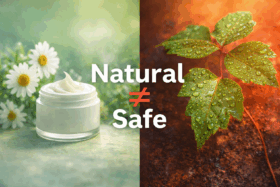
Reality: The term “natural” is often interpreted as meaning safer or healthier, but it has no consistent regulatory definition in cosmetics. Many naturally derived substances can cause irritation, sensitization, or toxicity depending on their concentration and use. For example, essential oils and botanical extracts—while plant-based—can contain potent bioactive compounds that affect the skin and body.11,12 Safety depends on dose, formulation, and exposure—not whether something is natural or synthetic.
Myth: If There’s No Reaction, It Must Be Safe
Reality: The absence of an immediate reaction does not necessarily indicate safety. Some effects—such as sensitization, endocrine disruption, or cumulative exposure—may develop gradually over time rather than producing an obvious short-term response.13,14 A product that feels fine today may still contribute to long-term exposure that is not immediately noticeable.
Myth: More Expensive Products Are Safer or Higher Quality
Reality: Price is not a reliable indicator of safety or formulation quality. Higher costs may reflect branding, marketing, packaging, or distribution rather than the actual ingredients used. While some premium products are well-formulated, others may contain similar or identical ingredients to lower-cost alternatives.15 Evaluating a product based on its ingredient list and transparency is more meaningful than relying on price alone.
Myth: “Dermatologist Tested” Means Proven Safe
Reality: The phrase “dermatologist tested” is not standardized and does not necessarily indicate how a product was tested, how many people were involved, or what the results were. In many cases, it simply means that a dermatologist was involved in some aspect of testing—not that the product was proven to be non-irritating or safe for long-term use.16 Without additional context, the term provides limited information about overall product safety.
What Consumers Can Do
The takeaway is not that every cosmetic is unsafe, or that consumers should panic. It is that people should stop assuming safety is fully established simply because a product is common, heavily marketed, or sold by a major brand.
Read ingredient lists. Learn to recognize broad umbrella terms such as “fragrance.” Use reputable databases and primary sources when possible. And support companies that are transparent about what they use and why they use it.
Because when assumptions replace scrutiny, marketing wins and consumers lose.
For Health,
Rob
References:
1. U.S. Food and Drug Administration. FDA Authority Over Cosmetics: How Cosmetics Are Not FDA-Approved, but Are FDA-Regulated. Updated November 18, 2025.
2. U.S. Food and Drug Administration. Color Additives. Updated March 20, 2026.
3. European Commission. Legislation: Cosmetic Products Regulation (EC) No 1223/2009. Accessed April 15, 2026.
4. U.S. Food and Drug Administration. Cosmetics Laws & Regulations. Accessed April 15, 2026.
5. Cosmetic Ingredient Review. How Does CIR Work? Accessed April 15, 2026.
6. Centers for Disease Control and Prevention. Biomonitoring Data Tables for Environmental Chemicals. Accessed April 15, 2026.
7. Anderson SE, Meade BJ. Potential health effects associated with dermal exposure to occupational chemicals. Environ Health Insights. 2014;8(Suppl 1):51-62.
8. Ferguson KK, Colacino JA, Lewis RC, Meeker JD. Personal care product use among adults in NHANES: associations between urinary phthalate metabolites and phenols and use of mouthwash and sunscreen. J Expo Sci Environ Epidemiol. 2017;27(3):326-332.
9. U.S. Food and Drug Administration. “Trade Secret” Ingredients. Updated March 26, 2024.
10. U.S. Food and Drug Administration. Fragrances in Cosmetics. Updated February 28, 2022.
11. U.S. Food and Drug Administration. “Natural” on Cosmetic Labeling. Updated 2022.
12. Nardelli A, et al. Allergic contact dermatitis from essential oils. Contact Dermatitis. 2008;59(4):237–244.
13. Gore AC, et al. Endocrine-disrupting chemicals: effects on endocrine systems. Endocr Rev. 2015;36(6):E1–E150.
14. Kortenkamp A. Low dose mixture effects of endocrine disruptors. Int J Androl. 2008;31(2):233–240.
15. Cosmetic Ingredient Review. Safety Assessment vs Marketing Claims. Accessed 2026.
16. U.S. Food and Drug Administration. Cosmetic Labeling Claims. Updated 2023.
Nature's Complement is a participant in the Amazon Services LLC Associates Program, an affiliate advertising program. If you purchase products on Amazon through any of our affiliate links, we get a small percentage of the transaction, at no extra cost to you. We spend a lot of time writing the articles on this site, and all this information is provided free of charge. When you use our affiliate links, you support the writing you enjoy without necessarily buying our products. (However we would appreciate if you would do that too!) Thank you for helping to support our work, however you choose to do so.
These statements have not been evaluated by the Food and Drug Administration. This information and/or products are not intended to diagnose, treat, cure or prevent any disease.