

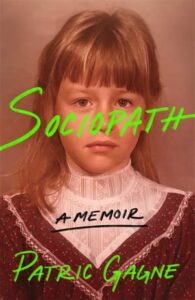
This is not an easy book to review, and that, in many ways, reflects the book itself.
Sociopath by Patric Gagne is a memoir written from the perspective of someone who identifies as having antisocial personality traits Rather than presenting a clinical explanation or a redemptive arc, the author offers a personal account of growing up feeling fundamentally different, navigating a world that did not have language or tolerance for those differences.
What stands out most is the author’s insistence on being seen as human, not monstrous. The book pushes back against the cultural shorthand that equates “sociopath” with villain, predator, or irredeemable danger. Instead, it portrays someone who is self-aware, intellectually curious, and deeply observant, even while acknowledging behaviors and thought patterns that fall outside social norms.
That said, this is not a book that offers comfort, nor does it ask for absolution. The author does not always apologize, soften, or moralize her actions. For some readers, this honesty will feel refreshing. For others, it may feel unsettling or incomplete. The narrative does not guide the reader toward judgment, but it also does not guide them toward reassurance.
Importantly, this is not a clinical manual, nor should it be read as representative of all individuals with antisocial personality disorder. It is one person’s experience, shaped by childhood, environment, gender expectations, and the absence of early diagnosis or support. At times, the book raises questions it does not fully answer, particularly around responsibility, harm, and accountability, and that ambiguity appears intentional.
What Sociopath does well is challenge the reader to sit with discomfort. It asks whether empathy must always look familiar, whether morality must always follow the same internal rules, and whether understanding is possible without approval. The book does not ask the reader to excuse harmful behavior, but it does ask them to consider how easily society dehumanizes those it does not understand.
This is a thoughtful, provocative read for readers interested in psychology, identity, and the limits of empathy. It may not be suitable for everyone, particularly those seeking clear moral framing or emotional resolution. But for readers willing to engage carefully and critically, Sociopath offers a rare perspective—one that complicates, rather than simplifies, a deeply stigmatized subject.
This is a book best approached slowly, thoughtfully, and with an understanding that complexity does not always come with closure.
Nature's Complement is a participant in the Amazon Services LLC Associates Program, an affiliate advertising program. If you purchase products on Amazon through any of our affiliate links, we get a small percentage of the transaction, at no extra cost to you. We spend a lot of time writing the articles on this site, and all this information is provided free of charge. When you use our affiliate links, you support the writing you enjoy without necessarily buying our products. (However we would appreciate if you would do that too!) Thank you for helping to support our work, however you choose to do so.
These statements have not been evaluated by the Food and Drug Administration. This information and/or products are not intended to diagnose, treat, cure or prevent any disease.