

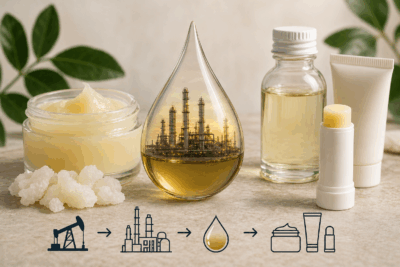
Petroleum-derived ingredients such as petrolatum, mineral oil, paraffin, and microcrystalline wax are widely used in personal care products. They can be found in moisturizers, lip balms, ointments, baby care products, hair products, and many other formulations.
For many consumers, these ingredients raise concern simply because of where they come from. Others dismiss those concerns because refined petroleum ingredients are commonly used and considered acceptable under current cosmetic and drug regulations when they meet applicable purity standards.1-4
The reality is more nuanced. The question is not simply whether these ingredients are “safe” or “toxic.” A better question is: what do they actually do, how are they made, what are their limitations, and are they the best choice for the product you are using?
What Are Petroleum-Based Ingredients?
Petroleum-based skincare ingredients begin with crude oil, a naturally occurring mixture of hydrocarbons formed from ancient organic material under heat and pressure. Through industrial refining, certain fractions are separated, purified, and processed into ingredients used in cosmetics, ointments, and personal care products.
Common petroleum-derived ingredients include petrolatum, mineral oil, paraffin, microcrystalline wax, ceresin, ozokerite, and some isoparaffins. These ingredients do not usually appear on a label as “petroleum,” which can make them harder for consumers to identify.
Historically, petroleum-derived ingredients became popular not because they were proven superior to all alternatives, but because they were inexpensive, widely available, chemically stable, and easy to formulate into consistent products at industrial scale.
How Are Petroleum-Based Ingredients Refined?
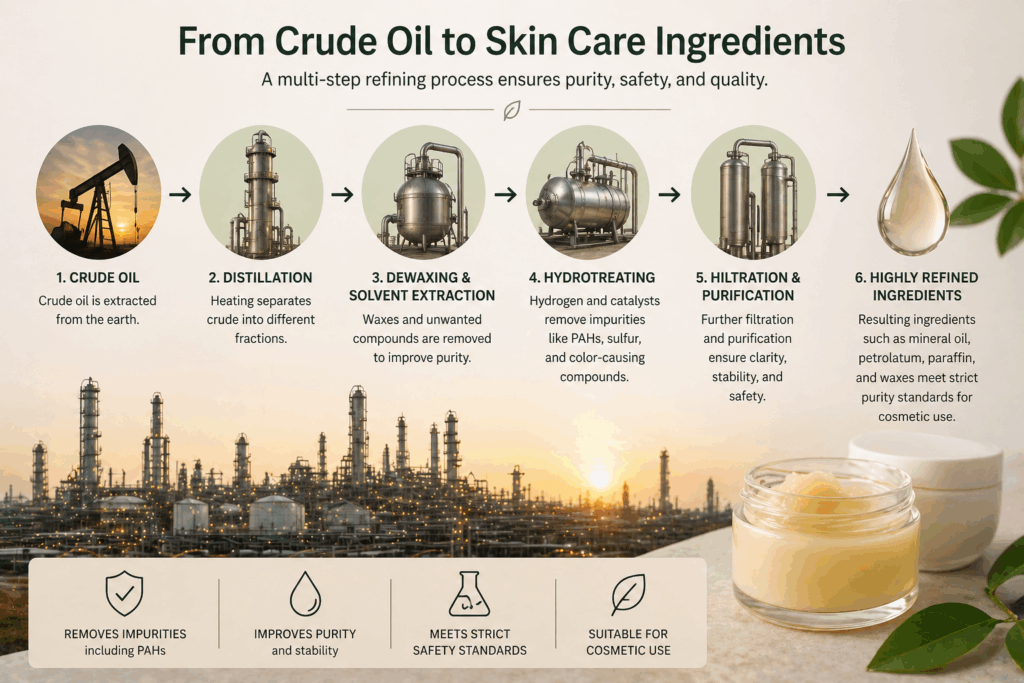
Petroleum refining is not a simple “scoop it out of the ground and put it in a jar” process. Crude oil is a complex mixture, and cosmetic-grade petroleum ingredients require substantial processing before they are suitable for use.
Refining may include distillation, solvent extraction, dewaxing, hydrotreatment, filtration, bleaching, and other purification steps depending on the ingredient being produced. These processes are intended to separate desired hydrocarbon fractions and remove impurities, including polycyclic aromatic hydrocarbons (PAHs), which are among the major toxicological concerns associated with unrefined petroleum materials.3,4,6
This is where nuance matters. Refining can reduce contaminants, but the quality of the final ingredient depends on the quality of the refining process, the testing performed, and the purity standards followed.
It is also fair to ask whether residual processing chemicals are a concern. In properly manufactured cosmetic-grade ingredients, residual solvents and processing agents should be removed or controlled to meet applicable standards. But as with any manufactured ingredient, trust depends on quality control, supplier integrity, and regulatory oversight.
Do Unrefined or Contaminated Forms Reach Consumers?
In regulated cosmetic markets, petroleum-derived ingredients used in personal care products are expected to meet purity standards.
In the European Union, mineral oils are only permitted in cosmetics if the full refining history is known and the starting material is not carcinogenic or the distillate is tested accordingly.3,4
In the United States, cosmetic ingredients generally do not require FDA premarket approval, with the exception of certain color additives. Manufacturers are legally responsible for product safety, but the burden of demonstrating compliance often rests with the manufacturer rather than a premarket approval system. As a result, confidence in ingredient purity depends heavily on supplier quality, testing practices, and regulatory compliance.
Many discussions of petroleum-derived ingredient safety focus on highly refined grades that meet established purity standards. Whether every finished product consistently meets those standards is a separate question. Consumers typically do not have access to the refining history, contaminant testing, or manufacturing records needed to independently verify those claims.
As a result, confidence in a finished product often depends on trust in manufacturers, suppliers, and regulatory oversight rather than independent verification by the consumer.
This is why “highly refined” is not a meaningless detail. It is the difference between discussing cosmetic-grade ingredients and discussing crude or poorly refined petroleum materials.
Why Are Petroleum-Based Ingredients Used?
Petroleum-derived ingredients are widely used in personal care products, but the reasons are not always the same reasons consumers choose a product.
Manufacturers often favor petroleum-derived ingredients because they are relatively inexpensive, widely available, chemically stable, and easy to formulate into products with predictable texture and shelf life. These characteristics can simplify manufacturing and help produce consistent products at large scale.
Some petroleum-derived ingredients have also been shown to reduce transepidermal water loss (TEWL), which is one reason they are commonly used in products intended to act as occlusive moisturizers.
However, manufacturing advantages should not automatically be confused with biological advantages. An ingredient may be inexpensive, stable, and easy to formulate with while still offering little in the way of vitamins, antioxidants, essential fatty acids, or other biologically active compounds.
Understanding this distinction helps explain why petroleum-derived ingredients remain common in the marketplace while also helping consumers ask a different question: not simply whether an ingredient works, but what purpose it serves and whether it aligns with their goals and values.
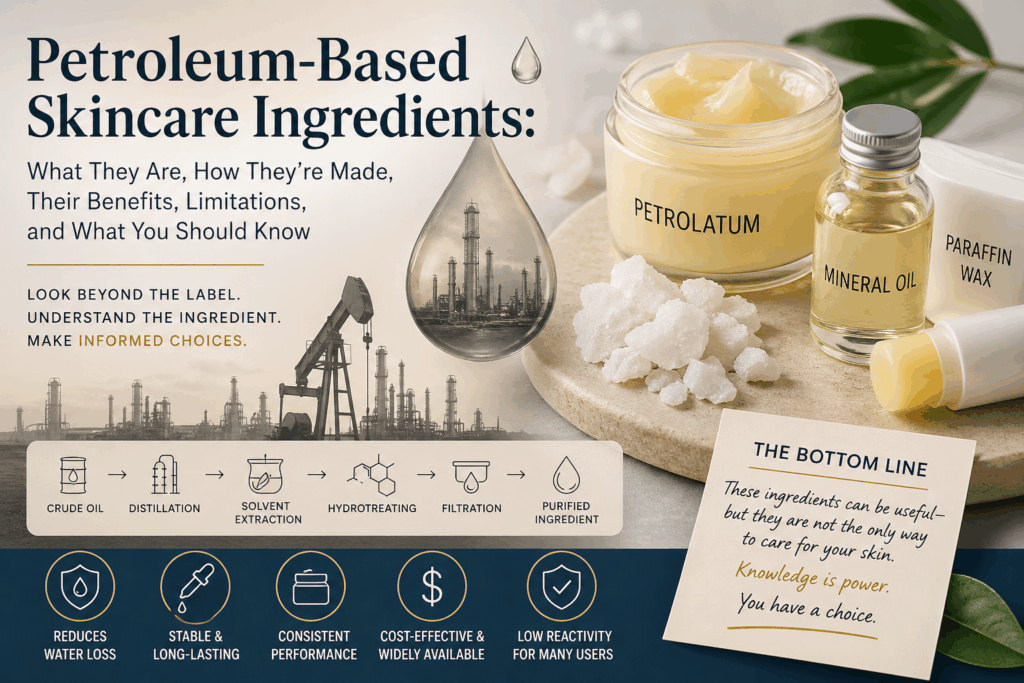
Common use does not automatically mean an ingredient is the best choice for every purpose.
Do Petroleum-Based Ingredients Absorb Into the Skin?
Research reviews suggest that highly refined mineral oils and waxes have limited dermal penetration under typical cosmetic use conditions and primarily remain on or within the outermost layers of the skin.7
Broader safety assessments and regulatory reviews have reached similar conclusions regarding the behavior and safety profile of these ingredients when properly refined and used as intended.8
While the available evidence suggests that highly refined mineral oils have limited dermal penetration under normal use conditions, questions remain regarding chronic exposure, damaged skin, repeated application, and cumulative exposure from multiple products. Also note the research shows limited dermal penetration. Limited is not the same as does not penetrate the skin.
Petroleum-derived ingredients are commonly used as occlusive ingredients because they have been shown to reduce transepidermal water loss. However, the precise mechanisms responsible for this effect are more complex than many consumer explanations suggest. Regardless of the mechanism, reducing water loss and providing nourishment are not necessarily the same thing.
That distinction matters. A barrier can be useful, especially for dry or compromised skin. But a barrier is not the same as nourishment, restoration, or biological support.

What We Still Don’t Know
Scientific uncertainty is often misunderstood. The absence of evidence for harm is not the same as evidence of safety under all conditions of use.
Most available safety assessments for highly refined petroleum-derived ingredients focus on acute toxicity, irritation, contamination levels, and typical patterns of cosmetic use. These are important considerations, but they do not answer every question consumers may have.
For example, many people use the same products daily for decades. Lip balms may be applied multiple times per day and small amounts may be ingested. Hand creams, lotions, and other personal care products may be reapplied throughout the day. While existing evidence does not necessarily demonstrate harm from these uses, long-term cumulative exposure is a different question than short-term safety.
Additional factors such as damaged skin, compromised skin barriers, repeated exposure from multiple products, individual susceptibility, and evolving manufacturing practices add further complexity.
This does not mean petroleum-derived ingredients are unsafe. It means that consumers should recognize the difference between what has been studied extensively, what appears reasonably well understood, and what remains uncertain.
As with many areas of science, confidence should be proportional to the available evidence rather than assumed simply because an ingredient has been widely used.
Do They Nourish the Skin?
Petroleum-derived ingredients are largely inert hydrocarbon mixtures. They can soften the skin, reduce moisture loss, and improve the feel of a product, but they do not naturally provide vitamins, antioxidants, essential fatty acids, phytosterols, or other bioactive plant compounds.
This does not make them useless. In some cases, reducing water loss is valuable. But it does mean their role is mostly protective and textural, not nutritive.
Plant-based oils and butters are more chemically complex. Depending on the ingredient, they may contain fatty acids, antioxidant compounds, vitamins, and other naturally occurring components that can support the skin in ways that go beyond simply coating the surface.
While plant-derived ingredients are often discussed in the context of allergies, it is important not to oversimplify the comparison. Petroleum-derived ingredients are often assumed to be less likely to trigger certain types of allergic responses due to their relatively inert nature, but allergic reactions are not the only measure of compatibility.
Some consumers may experience irritation, breakouts, follicular congestion, or other unwanted effects that are not necessarily classified as allergies. In addition, adverse reactions are not always formally reported, recognized, or linked back to a specific ingredient.
The absence of widespread allergy reports should not be interpreted as proof that an ingredient is ideal for every individual or every application.
However, plant-based ingredients are not automatically perfect either. They can oxidize, vary in quality, trigger allergies in some individuals, or require more careful preservation depending on the formula. The point is not that every natural ingredient is good and every petroleum-derived ingredient is bad. The point is that these ingredients serve different purposes, and consumers deserve to understand the difference.
Have Petroleum-Based Products Been Linked to Harm?
There are documented cases in the medical literature where petroleum-based substances have been associated with adverse effects. However, these cases are highly dependent on how the product is used.
For example, rare cases of lipoid pneumonia have been reported when oil-based substances, including petroleum jelly, are repeatedly inhaled or aspirated into the lungs. This has been observed in situations such as chronic intranasal use.1
Petroleum-based products are also not recommended for use around oxygen therapy equipment due to flammability concerns in oxygen-rich environments.
In addition, concerns about petroleum-derived ingredients have historically centered on contamination with polycyclic aromatic hydrocarbons (PAHs), which are removed during proper refining. This is why regulatory safety assessments apply specifically to highly refined grades.
These examples highlight an important principle: risk is not determined by the ingredient name alone, but by factors such as purity, formulation, route of exposure, and context of use.
But there are many considerations that are rarely studied, and rarely discussed. Long-term exposure does not automatically imply harm, but long-term use patterns are distinct from short-term safety assessments and deserve consideration when evaluating ingredients used daily over many years. For example, a person using lip balm 5 to 10 times per day for 30 years may ingest a measurable amount of product over time. But I could not find any papers that specifically studied such exposure and its consequences.
Key Point:
Demonstrating a lack of known risk is not the same thing as demonstrating the absence of risk.
What About Fragrance and Product Formulation?
Highly refined petroleum-derived ingredients are often odorless or nearly odorless. However, many finished products include fragrance to create a more pleasant sensory experience or to support a specific brand identity.
Fragrance can be listed simply as “fragrance” or “parfum,” and the individual components of that fragrance mixture are not always disclosed on the product label.5
This does not mean every fragranced product is harmful. But it does add another layer of uncertainty for consumers who are trying to understand exactly what they are putting on their skin.
A product may look simple at first glance, but if it contains undisclosed fragrance components, the label may not tell the full story.
How to Identify Petroleum-Derived Ingredients
Petroleum-derived ingredients often appear under different names on product labels. Understanding what to look for can help you make more informed decisions.
| Ingredient Name | What It Is | Source | Processing Snapshot | Primary Function |
|---|---|---|---|---|
| Petrolatum | Semi-solid mixture of hydrocarbons | Crude oil | Separated, refined, purified, and tested for impurities | Occlusive barrier; reduces water loss |
| Mineral Oil | Liquid hydrocarbon mixture | Crude oil | Distilled and highly refined to remove aromatic compounds | Emollient; surface smoothing; barrier support |
| Paraffin | Wax-like hydrocarbon fraction | Crude oil | Refined, purified, and solidified into wax fractions | Texture, structure, and barrier formation |
| Microcrystalline Wax | Dense wax with smaller crystal structure | Petroleum wax fraction | Dewaxed, refined, and purified | Thickening, structure, and product stability |
| Ceresin | Refined mineral wax | Mineral waxes | Purified and often bleached | Thickening, texture, stabilization |
| Ozokerite | Naturally occurring mineral wax | Mineral deposits associated with petroleum sources | Refined and purified before cosmetic use | Hardness, structure, and texture |
| Isohexadecane / Isoparaffins | Branched hydrocarbons | Petroleum-derived or synthetically produced hydrocarbons | Highly processed and purified | Lightweight emollient; silky feel |
Many of these ingredients do not include the word “petroleum” on the label, which can make them difficult for consumers to recognize.

Oils can look nearly identical. The label is what tells the real story.
Red Flags & Clues: How to Spot Petroleum-Based Formulations
These signs do not automatically mean a product is harmful, but they can help you recognize when petroleum-derived ingredients may be playing a major role in a formulation.
- Ingredients like petrolatum, mineral oil, paraffin, or microcrystalline wax listed near the top
Ingredients are generally listed in descending order by predominance, so petroleum-derived ingredients near the top usually indicate they make up a significant portion of the product. - Very long shelf life with minimal preservation needs
Petroleum-derived ingredients are chemically stable and resistant to oxidation, which can reduce formulation challenges compared with more fragile oils. - Very low cost relative to product size
Petroleum-derived ingredients are widely available and often inexpensive, which makes them attractive in large-scale manufacturing. - Texture that sits on the skin rather than absorbing
Many petroleum-based products feel smooth and protective, but they primarily remain on the surface and reduce water loss rather than deeply nourishing the skin. - Limited variety of active or nutritive ingredients
Products built mainly around barrier ingredients may lack the fatty acids, antioxidants, vitamins, and plant compounds found in less inert oils and butters. - Use of “fragrance” or “parfum” without further detail
Fragrance may be added to improve the sensory experience, and the individual components of fragrance mixtures are often not fully disclosed on the label.5 - Marketing language that emphasizes softness but not ingredient function
A product may make skin feel coated, smooth, or protected without necessarily supporting skin function beyond barrier formation.
These observations are best used together rather than in isolation. A single characteristic does not define a product, but patterns can provide useful insight into how a formulation is built.
You should be asking yourself the question: “What is this product actually doing for my skin?”
Environmental Considerations
Another consideration is the environmental cost of transforming crude oil into highly refined cosmetic ingredients. Petroleum-derived ingredients used in personal care products do not begin as cosmetic-grade materials. They undergo multiple refining and purification steps designed to remove contaminants, separate specific fractions, and meet applicable purity standards.
Each refining step may improve purity, but it also requires additional energy, resources, and industrial processing.
These processes require energy, infrastructure, transportation, and industrial processing. While refining may improve ingredient purity, it also carries its own environmental footprint. The resources required to extract, transport, refine, test, and distribute petroleum-derived ingredients are rarely discussed when evaluating the sustainability of a finished product.
Another environmental question receives surprisingly little attention: what happens after these ingredients are washed off the skin?
Petroleum-derived ingredients do not simply disappear once they enter wastewater systems. Depending on the ingredient and the treatment process, some may be removed during wastewater treatment while others may enter the broader environment. The environmental fate of many petroleum-derived cosmetic ingredients is less frequently discussed than their safety during cosmetic use.
This does not necessarily mean these ingredients pose a significant environmental risk. Rather, it highlights another area where questions remain. An ingredient can meet current safety standards for cosmetic use while still raising separate questions regarding sustainability, environmental persistence, wastewater treatment, and long-term ecological impact.
Consumers often ask whether these ingredients are safe for people, while spending far less time asking what happens to them after they leave the product and enter the environment.
This does not automatically make petroleum-derived ingredients environmentally unacceptable. Rather, it highlights that the environmental conversation extends beyond what happens after a product is used. The environmental impact of an ingredient includes its entire life cycle, from sourcing and processing to use and disposal.
Petroleum vs. Plant-Based Alternatives
Petroleum-derived ingredients are often used because manufacturers view them as stable, inexpensive, predictable, easy to formulate with, and effective at reducing water loss. Plant-based oils and butters are often used because they provide a broader range of naturally occurring compounds and can support skin feel, moisture, and nourishment in different ways.
For example, ingredients such as shea butter, cocoa butter, olive oil, coconut oil, jojoba oil, sunflower oil, and other plant-derived oils each have distinct fatty acid profiles and formulation characteristics.
That does not mean every plant oil is right for every person. Some people are allergic to certain botanicals. Some oils are comedogenic for some skin types. Some are fragile and oxidize quickly if not handled properly. But they are not simply inert barriers. They can bring additional composition and function to a formula.
This is why the conversation should not be reduced to fear. It should be about purpose. What is the ingredient doing? Why is it there? Is it necessary? Is there a better option? And does it align with your values?
Conclusion: You Do Have a Choice
Petroleum-based ingredients are not always the villain they are made out to be, but they are also not automatically the best choice simply because they are common, stable, and widely accepted. Their safety profile depends on refinement, purity, quality control, intended use, duration of exposure, and the limitations of the available evidence.
Common use should not be confused with complete understanding. Many ingredients become widely adopted because they are effective, economical, and easy to formulate with. Those factors can coexist with unanswered questions regarding long-term exposure, cumulative use, environmental impact, or whether better alternatives exist for a particular application.
It is easy to assume these ingredients are necessary because they appear in so many products. But in many cases, they are not the only option. They are often chosen because they are inexpensive, stable, consistent, and easy to formulate with. Not because they are the only way to support healthy skin, but because they are convenient, stable, and cost-effective.
Consumers do have a choice. We can choose products that act primarily as a barrier, or we can choose products formulated with ingredients that may provide additional fatty acids, antioxidants, vitamins, or other biologically active compounds. We can choose products that rely on vague fragrance formulas, or we can choose products with greater ingredient transparency. We can choose convenience, or we can choose to ask better questions.
As always, the first step is simple: read the label. The ingredient list tells a story, but only if we know how to read it.
For Health,
Tober
References:
1. U.S. Food and Drug Administration. Cosmetics Ingredients. https://www.fda.gov/cosmetics/cosmetic-products/cosmetics-ingredients
2. Cosmetic Ingredient Review. Cosmetic Ingredient Review Expert Panel Safety Assessments. https://www.cir-safety.org
3. European Commission. CosIng Database: Cosmetic Ingredients and Substances. https://ec.europa.eu/growth/tools-databases/cosing/
4. Bundesinstitut für Risikobewertung (BfR). Highly Refined Mineral Oils in Cosmetics: Health Risks Are Not to Be Expected According to Current Knowledge. 2018. https://www.bfr.bund.de/cm/349/highly-refined-mineral-oils-in-cosmetics-health-risks-are-not-to-be-expected-according-to-current-knowledge.pdf
5. U.S. Food and Drug Administration. Fragrances in Cosmetics. Updated February 28, 2022. https://www.fda.gov/cosmetics/cosmetic-ingredients/fragrances-cosmetics
6. European Parliament and Council of the European Union. Regulation (EC) No 1223/2009 on Cosmetic Products. Annex II restrictions related to petroleum-derived substances when full refining history is not known or carcinogenic potential cannot be excluded. https://eur-lex.europa.eu/legal-content/EN/TXT/?uri=CELEX:32009R1223
7. Petry T, Bury D, Fautz R, et al. Review of data on the dermal penetration of mineral oils and waxes used in cosmetic applications. Toxicology Letters. 2017;280:70-78. https://pubmed.ncbi.nlm.nih.gov/28789996/
8. Chuberre B, Araviiskaia E, Bieber T, Barbaud A. Mineral oils and waxes in cosmetics: An overview mainly based on the current European regulations and the safety profile of these compounds. Journal of the European Academy of Dermatology and Venereology. 2019;33(Suppl 7):5-14. https://pubmed.ncbi.nlm.nih.gov/31588613/
Nature's Complement is a participant in the Amazon Services LLC Associates Program, an affiliate advertising program. If you purchase products on Amazon through any of our affiliate links, we get a small percentage of the transaction, at no extra cost to you. We spend a lot of time writing the articles on this site, and all this information is provided free of charge. When you use our affiliate links, you support the writing you enjoy without necessarily buying our products. (However we would appreciate if you would do that too!) Thank you for helping to support our work, however you choose to do so.
These statements have not been evaluated by the Food and Drug Administration. This information and/or products are not intended to diagnose, treat, cure or prevent any disease.