

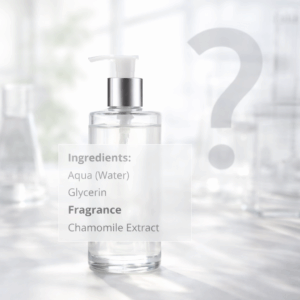
Originally published in 2010, the discussion around fragrance disclosure remains relevant today. The regulatory framework governing cosmetic labeling in the United States has not substantially changed, yet many consumers still assume that ingredient labels provide full compositional transparency.
That assumption becomes complicated when a product lists a single word: “fragrance.”
So how many ingredients can actually be hidden behind that term?
The exact number varies depending on database updates and methodology, but the broader issue of limited disclosure remains.
The Environmental Working Group (EWG) has long pointed out that a substantial number of chemical compounds may be used within fragrance formulations across personal care and household products. Under current U.S. labeling law, manufacturers are not required to disclose the individual components of proprietary fragrance blends.1 Some fragrance constituents have been studied for allergenicity, sensitization potential, or endocrine activity.2,3 The difficulty for consumers is that without disclosure, meaningful personal risk assessment becomes challenging.
This structure exists because U.S. cosmetic labeling regulations recognize fragrance formulas as proprietary trade secrets. As a result, companies may list “fragrance” or “parfum” rather than each individual component.1 This policy is described directly in FDA labeling guidance, which is publicly available for review. You can read the detailed legal policy on the FDA’s own web site here and here.
EWG has argued that when consumers see the word “fragrance,” they should recognize that it represents an undisclosed mixture rather than a single ingredient. While we do not automatically adopt every position taken by advocacy groups, the structural point here is accurate: the term “fragrance” does not provide specific compositional information to the consumer.
The International Fragrance Association (IFRA) has published transparency lists identifying substances that may be used by its members in fragrance creation. While this represents an effort toward industry openness, the practical limitation remains: the publication of a master list does not inform consumers which specific components are present in any given product labeled “fragrance.” IFRA maintains a public library of standards and ingredient-related documentation on their official website.
So How Many Ingredients Can Be Hidden Behind the Word “Fragrance”?
The most accurate answer is: potentially thousands.
Industry transparency lists maintained by organizations such as IFRA identify several thousand substances that may be used in fragrance creation. However, those lists do not reveal which specific components are present in any individual product labeled “fragrance.” Because fragrance formulas are protected as proprietary blends under current U.S. regulations, the exact number in a given product remains unknown to the consumer.
The issue is not a single dramatic number. It is structural. When disclosure is replaced by a catch-all term, the consumer is asked to accept uncertainty. Some are comfortable doing so. Others prefer full ingredient visibility in order to make informed choices aligned with their own sensitivities and priorities.
For us, ingredient transparency is closely tied to consumer trust. At Nature’s Complement, we list each ingredient individually and avoid the use of undisclosed fragrance blends. We believe consumers should be able to evaluate products based on clear information rather than assumptions. Our formulations reflect that philosophy, and we stand behind them with a satisfaction guarantee.
For Health,
Rob
References
1. U.S. Food & Drug Administration. Cosmetics Labeling Guide – Fragrance and trade secret provisions.
https://www.fda.gov/cosmetics/cosmetics-labeling-regulations/cosmetics-labeling-guide
2. Steinemann, A. (2016). Fragranced consumer products: exposures and effects. Air Quality, Atmosphere & Health.
https://link.springer.com/article/10.1007/s11869-016-0442-z
3. de Groot, A.C. (2016). Contact allergy to fragrances: current clinical and regulatory aspects. Dermatitis.
https://pubmed.ncbi.nlm.nih.gov/27427818/
Nature's Complement is a participant in the Amazon Services LLC Associates Program, an affiliate advertising program. If you purchase products on Amazon through any of our affiliate links, we get a small percentage of the transaction, at no extra cost to you. We spend a lot of time writing the articles on this site, and all this information is provided free of charge. When you use our affiliate links, you support the writing you enjoy without necessarily buying our products. (However we would appreciate if you would do that too!) Thank you for helping to support our work, however you choose to do so.
These statements have not been evaluated by the Food and Drug Administration. This information and/or products are not intended to diagnose, treat, cure or prevent any disease.