

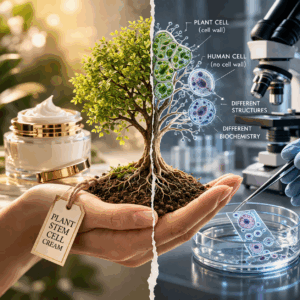
Recently, it has become trendy in the personal care industry to promote products that contain “plant stem cells,” often accompanied by claims of remarkable or even “miracle” benefits. In many cases, these claims are misleading—both in how the term is used and in what is actually present in the final product. In this article, I will break down exactly why that is.
Last Updated: Apr 2026
The biology here is not overly complicated, so once we apply a little logic to the science, it becomes very clear. There is a familiar figure of speech about “putting lipstick on a pig,” and that concept applies well in this case.
The primary reason this marketing trend exists is because the term “stem cell” is an effective way to mislead consumers. It creates confusion between plant stem cells and human stem cells, such as embryonic stem cells or induced pluripotent stem cells (iPS). The latter are human cell lines with legitimate therapeutic potential for human skin and other tissues. Plant stem cells are not. There is no credible scientific evidence, nor a sound biological mechanism, to support claims that plant stem cells provide regenerative benefits to human skin cells. Yet the term continues to be heavily promoted. Simply using the phrase “stem cell” taps into what people associate with human regenerative medicine, even though the two have nothing in common. As mentioned, there is real therapeutic promise in human stem cells, but “plant stem cells” have nothing to do with these.
First of all, the fundamental nature of animal cells and plant cells is dramatically different, as even a basic review of cell biology will show. The biochemical processes, hormones, signaling molecules, and cellular structures are all distinct. Plant hormones do not affect animal cells, as animal cells do not have the appropriate receptors for those signals, nor do they share the same physiological pathways.

The structures and functions of plant cells do not translate in any meaningful way to animal cells. Plant stem cells do not produce fibroblasts, they do not produce collagen or elastin, and they do not generate human growth factors. In short, they do not contribute to the cellular processes that maintain or repair human skin.
The primary benefit of stem cells within an organism is their ability to replace cells lost to damage or cellular senescence. That process is species-specific. Plant cells do not perform this function in humans. And even setting biology aside for a moment, the idea of repopulating human skin with rigid, cell wall–containing plant cells should immediately raise questions about compatibility.
There is also a more practical issue that is often ignored: viability. Any so-called “plant stem cells” included in cosmetic formulations are almost certainly non-viable by the time they reach the final product. Standard industrial processing, preservation systems, and shelf stability requirements are not compatible with maintaining living cells.
If you search peer-reviewed scientific literature (for example, through PubMed), you will not find credible experimental evidence demonstrating that plant stem cells provide regenerative benefits to human skin. What you will find instead are publications that discuss plant cell extracts or theoretical mechanisms, often without controlled experiments, clinical data, or direct evidence of efficacy in human tissue.
In fact, even within these publications, there are occasional admissions worth noting. For example, some acknowledge that cosmetic products marketed as containing “stem cells” typically contain extracts derived from plant cells, not live stem cells themselves. That distinction is critical—and it is often overlooked in marketing.
These publications also make completely unsupported claims, such as stating that “specialized peptides and enzymes or plant stem cells which, when applied topically, help protect the skin’s own stem cells from damage or stimulate them.” If you examine the references provided for statements like this, you will not find experimental data or controlled studies demonstrating that plant stem cells have any such effect on human skin.¹
“Stimulate” the skin’s own stem cells to do what, exactly? Through what mechanism? These are fundamental questions that are left unanswered.
It is also important to recognize how different categories of compounds are being grouped together in a misleading way. Peptides, enzymes, and plant stem cell extracts are entirely different in structure and biological function. Some peptides and enzymes have been studied for potential effects on skin, depending on their specific composition and ability to interact with human cellular pathways.²⁻⁴ Plant stem cells, however, do not share these properties. Presenting all of these as having equivalent effects is scientifically inaccurate and creates confusion for the consumer.
How can you tell that the articles referenced above are “marketing publications” rather than legitimate scientific research? The answer is straightforward: read them carefully, sentence by sentence, and verify the references they cite.
When doing so, two consistent patterns emerge:
1. Irrelevant or indirect references.
Many of the cited references discuss topics such as plant cultivation methods or general principles of plant biology. While those may be valid areas of study, they are not relevant to the claims being made. They do not include clinical trials demonstrating improvements in human or animal skin following application of “plant stem cells,” nor do they present even basic in vitro (petri dish) evidence showing effects on human skin cells.
2. References that do not contain supporting data.
In other cases, the cited “references” are themselves articles that make similar claims but provide no experimental data, no controlled studies, and no measurable results. In other words, they do not substantiate the claims they are being used to support. This creates a chain of citations that appears credible on the surface, but lacks any real scientific foundation.⁵
On top of that, many of the so-called “references” used in these publications appear to rely on a form of circular citation. In these cases, one article references another, which then references back to the original, often within a small network of authors or affiliated organizations. While this may create the appearance of credibility, it does not constitute independent validation or scientific evidence.⁶
In reviewing these materials, what becomes clear is that they lack the fundamental elements of scientific research: controlled experiments, reproducible methods, and measurable data. Instead, they consist largely of unsupported claims presented in a format that resembles scientific literature, but without meeting the standards required for actual evidence-based conclusions.⁷
I don’t know about you, but to me, that starts to look less like science and more like a shell game—one designed to give the illusion of legitimacy while ultimately separating people from their money.
But setting the marketing aside for a moment, let’s return to the more important question: could plant stem cells—even under ideal conditions—provide any meaningful benefit to human cells?
Even if these so-called “plant stem cells” were somehow still viable, and even if they were capable of performing biochemical functions after application (which is highly unlikely given the fundamental differences between plant and mammalian biology), there is an additional and significant barrier: biological compatibility.
The human immune system is designed to recognize and respond to foreign cells. Introduction of non-self cellular material is typically treated as a potential threat, often triggering immune responses rather than integration into normal physiological processes.⁸ This is why even human-to-human organ transplants require careful matching and immunosuppression to avoid rejection.⁹ The idea that plant-derived cells could integrate with or beneficially influence human skin cells is not supported by immunological principles.
At best, foreign cellular material applied topically would be biologically inert. At worst, it could contribute to irritation or inflammatory responses, depending on the formulation and the individual’s sensitivity.
Now, some may argue that it is not the plant stem cells themselves providing benefit, but rather certain compounds they contain—such as so-called “growth factors” or other bioactive molecules—that are responsible for the observed effects.

As discussed above, human and plant biochemistry are fundamentally different, making it highly unlikely that plant-derived growth factors would have any meaningful effect on mammalian (human) cells. There is no credible evidence demonstrating that plant “stem cell”–derived growth factors can interact with or regulate human cellular processes in the way these products often suggest.¹⁰⁻¹¹
That said, certain compounds found in plants may have biological activity relevant to skin, such as antioxidant or pro- and anti-inflammatory effects.¹²⁻¹³ However, these properties are not unique to “plant stem cells.” They are common to a wide range of plant-derived ingredients and extracts that have been studied independently of any stem cell-related claims.
In other words, the use of the term “stem cells” in this context does not reflect a unique or enhanced biological function. It is a marketing-driven label that capitalizes on the public’s association of stem cells with regeneration and advanced medicine, despite lacking a mechanistic or evidence-based foundation. The same general effects attributed to these products can be achieved through far simpler and more transparent plant-based ingredients, often at a fraction of the cost.
At that point, the phrase “plant stem cell” stops being a meaningful scientific descriptor and starts functioning primarily as a marketing term.

A common response to all of this might be, “But I’ve used a plant stem cell cream and it worked great for my skin, so there must be something to it.” And my response to that is simple: that’s great—I’m glad you found a product that works for you. But take a closer look at the ingredient list. What you will often find is that the benefits are coming from other active ingredients in the formulation, not from anything labeled as “plant stem cells.”
In some cases, those effects may be due to well-known compounds such as moisturizers, antioxidants, or other bioactive ingredients. In other cases, it may even be due to ingredients that are not clearly disclosed. But in either case, there is no evidence that “plant stem cells” themselves are responsible for those results.
And of course, it is also important to consider the role of the placebo effect—where perceived improvement can occur simply because a person expects a product to work.¹⁴
Personal care product marketers are unlikely to abandon this practice as long as it remains profitable. As long as the strategy continues to work economically, it will continue to be used—even if it comes at the expense of scientific accuracy and long-term credibility.
Companies that choose to operate differently invest in real research, formulate products with purpose, and are transparent about why their products work. They do not rely on vague or misleading terminology to create perceived value.
Since this practice is unlikely to disappear on its own, the most effective response is in the hands of consumers. The best way to discourage misleading marketing is to avoid financially supporting it. That means looking beyond the label, asking for real evidence, and choosing products backed by clear ingredients and credible data.
Until then, you vote with your wallet every single day.

For Health,
Rob
References:
1. Gupta A, et al. Plant stem cells in cosmetics: current trends and future directions. J Cosmet Dermatol. 2020;19(9):2112-2117.
2. Lintner K, Peschard O. Biologically active peptides: from a laboratory bench curiosity to a functional skin care product. Int J Cosmet Sci. 2000;22(3):207-218.
3. Gorouhi F, Maibach HI. Role of topical peptides in preventing or treating aged skin. Int J Cosmet Sci. 2009;31(5):327-345.
4. Fields K, Falla T, Rodan K, Bush L. Bioactive peptides: signaling the future. J Cosmet Dermatol. 2009;8(1):8-13.
5. Ioannidis JPA. Why most published research findings are false. PLoS Med. 2005;2(8):e124.
6. Greenberg SA. How citation distortions create unfounded authority: analysis of a citation network. BMJ. 2009;339:b2680.
7. Glasziou P, et al. Reducing waste from incomplete or unusable reports of biomedical research. Lancet. 2014;383(9913):267-276.
8. Murphy K, Weaver C. Janeway’s Immunobiology. 9th ed. Garland Science; 2016.
9. Hall JE. Guyton and Hall Textbook of Medical Physiology. 14th ed. Elsevier; 2021.
10. Xu X, et al. Plant-derived bioactive compounds and their effects on skin health. Int J Mol Sci. 2020;21(24):9635.
11. Georgiev V, et al. Plant cell cultures as a source of cosmetic active ingredients. Eng Life Sci. 2018;18(11):779-798.
12. Nichols JA, Katiyar SK. Skin photoprotection by natural polyphenols: anti-inflammatory, antioxidant and DNA repair mechanisms. Arch Dermatol Res. 2010;302(2):71-83.
13. Działo M, et al. The potential of plant phenolics in prevention and therapy of skin disorders. Int J Mol Sci. 2016;17(2):160.
14. Benedetti F. Placebo Effects: Understanding the Mechanisms in Health and Disease. 2nd ed. Oxford University Press; 2014.
Nature's Complement is a participant in the Amazon Services LLC Associates Program, an affiliate advertising program. If you purchase products on Amazon through any of our affiliate links, we get a small percentage of the transaction, at no extra cost to you. We spend a lot of time writing the articles on this site, and all this information is provided free of charge. When you use our affiliate links, you support the writing you enjoy without necessarily buying our products. (However we would appreciate if you would do that too!) Thank you for helping to support our work, however you choose to do so.
These statements have not been evaluated by the Food and Drug Administration. This information and/or products are not intended to diagnose, treat, cure or prevent any disease.

*Laughing* I have not even heard of ‘plant stem cells’. That said everything you said makes sense on the topic. Just the fact that it is from a completely different kind of organism is all I would need to know to question if there was anything to it. Add in the question of if the cells are still alive and there is no question of it being real. *shakes head at the idea of people falling for such marketing*