

Several years ago when Nature’s Complement was just beginning to become a real thing, I had an overwhelming amount of support. Many who knew me, and my own struggles with skin issues, were incredibly supportive of my effort to finally create quality products for others on a more official basis. The support came in many ways, including
those who bought my early products to help me grow, those who helped me get into a few local stores, and those who offered much-needed moral support. At the time, I was surprised that so many people kept telling me, “you’ll be rich.” I didn’t yet understand how personal care products had become so closely associated with financial success.
Last Updated: Apr 2026
The idea of becoming rich as a result of producing skin creams was never my motivation. My goal has always been to provide products made with ingredients I personally feel good about using—products I believe avoid unnecessary or questionable additives and focus on simplicity.
In today’s world, it can sometimes feel like honesty isn’t what drives success, and over time I began to understand why so many people associate skin care with high profits. There is a widespread perception that skin creams = profits. (By the way, sorry to have disappointed you all.) It’s such a common belief that many assume anyone creating a quality product will quickly become wealthy. The reality, at least in my experience, doesn’t work that way.
I’m Not Rich
Yes, I make products using high-quality ingredients, and I avoid the use of many common synthetic preservatives and additives. This means that my products don’t always behave the way people might expect from conventional options. That’s part of the tradeoff. Products made without those stabilizing ingredients can act differently than what we’re used to seeing in commercials.
They still perform, of course, but sometimes it takes a little getting used to—how they feel, how they’re applied, and even how they’re stored. In some cases, that includes things like refrigeration. Natural formulations often require a bit more care and understanding. And while I do my best to keep prices as low as possible, organic raw oils… umm… yeah… not cheap.
Why Other Manufacturer’s Are Rich
The people who work for large manufacturers are not necessarily the ones benefiting the most financially. Many roles throughout the supply chain, whether in production, packaging, or raw material sourcing, often operate on tight margins. Some raw materials, especially specialty and organic oils, are time- and energy-intensive to produce, which adds to their cost long before they ever reach the final product.
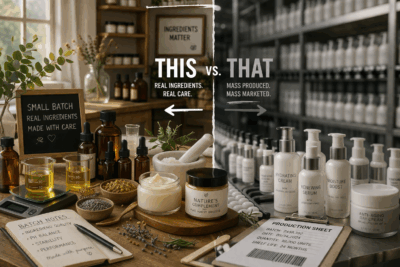
So where does the money go? In many cases, large-scale success comes down to branding, distribution, and marketing. Large companies have the resources to build massive brand recognition and maintain it through constant advertising. That kind of visibility can shape consumer perception in powerful ways.
I remember having a conversation with someone who was convinced a $400 skin cream was worth every penny because of how it was made. There was a whole story behind it—ingredients fermented for months, special processes, rare components. It sounded impressive. And maybe some of it has value. But it also made me step back and ask a simple question: how much of that price is the formulation… and how much of it is the story?
In the personal care industry, pricing is not always directly tied to the cost of ingredients. It is not uncommon for products to be sold at a significant markup, supported by narratives about unique processes or rare ingredients. Sometimes those details matter, and sometimes they seem to function more as part of the overall appeal than as something that meaningfully changes the outcome.
That does not mean every expensive product is ineffective. It does mean that consumers should look beyond the label and beyond the advertising. Price, presentation, and branding do not always reflect the true nature or quality of what is inside the jar.
From my perspective, that is where perception can drift away from reality. And when that happens, it becomes much easier for premium pricing to feel justified, whether or not the product itself truly warrants it.

When I first started manufacturing my own products, I had to quickly learn some realities of being a producer. Raw materials cost money. Shipping them costs money. Turning them into a final product costs money. Advertising them costs a LOT of money. Selling them costs money. Everything related to the production of soap and other personal care products costs money. The only thing that really changes is how much.
As a small business, I pay higher premiums for raw materials because I don’t need to order 10,000 units at a time. My order of 1,000 jars barely offers a price break. There seems to be this “magic number” where costs start to drop significantly, but I don’t have the space or the funds to operate at that scale across every product.
Larger manufacturers can operate at that level, and that changes everything. Their cost per unit drops, their margins improve, and their pricing flexibility increases. For a small business, a markup is often what allows us to continue operating. For larger companies, those same markups can translate more directly into profit once the system is fully scaled.
Established brands also have the advantage of widespread distribution and ongoing advertising that keeps them in front of consumers. That visibility plays a major role in maintaining demand, sometimes regardless of the underlying formulation.
From my perspective, that creates a very different set of incentives. As a small business, I don’t have the option to rely on volume, scale, or massive marketing campaigns. The only way I can compete is by focusing on the quality of the ingredients and the integrity of the formulation, even if that means higher costs and more limitations in how the product behaves or how long it lasts.
I could lower costs by changing those choices, but that would mean moving away from the standards I’ve set for myself. And that’s not something I’m willing to do. So maybe that just means I’m not going to get rich… at least not by that method.
Actually, I Work For Free
I’ve learned a lot in starting a small business from scratch. One of the most important things I’ve learned is that it costs a lot of money just to run a business. But in order to make money, I need products to sell. And people won’t buy products if they are too expensive, so there’s always a balance to find.
To keep prices low, overhead has to stay low. Not an easy task. An ad-free website costs money. A domain name costs money. SSL certificates cost money. Every feature I want to add to the site (or sometimes have no choice but to add) costs money. Then there’s ongoing website maintenance. And that’s just the website side of things.
There are also merchant fees. Most people use credit cards (though a few still write old-fashioned checks), and we’re working on adding cryptocurrency payments. But all of those transactions, except checks and Zelle, cost money on my end.
Then there are the physical costs: containers (which are sold separately from lids), raw ingredients, pH meters, temperature sensors, extra refrigeration capacity… and on and on. Someone has to handle accounting and taxes. Someone has to deal with damaged shipments and file claims. Someone has to actually make the products, label them, package them, and ship them out.
And that’s not even everything. There’s rent, power, equipment that breaks and needs repair, and batches that don’t pass quality control and can’t be sold. To keep overhead manageable, we do as much of this ourselves as possible. But some things still require outside help.
Then there’s product research, testing, quality control, and inventory. That list keeps going too. And of course, COVID didn’t make anything easier. Supply chains shifted, suppliers changed, applications had to be resubmitted, shipping times increased, and product availability dropped. That list goes on just like the rest.
By no means am I complaining. I actually enjoy my portion of the work, especially the research. But when it all balances out… I essentially work for free.
Why Even Bother?
The fact of the matter is, large manufacturers operate under a very different set of priorities than small businesses like mine. Their focus is often on scale, consistency, shelf stability, and meeting the demands of widespread distribution. That requires formulation choices that allow products to sit on shelves for extended periods of time and perform consistently across a wide range of conditions.
From my perspective, that approach doesn’t always align with the kind of products I want to create or use. My goal has always been different. I focus on formulations that prioritize ingredient selection and simplicity, even if that means shorter shelf life, different handling requirements, or a product that behaves a little differently than what people may be used to.
That’s where I come in. That’s why I started this business—not because I thought I’d get rich, but because I wanted access to products that I personally felt comfortable using for myself and my family. Over time, I’ve found that there are others who feel the same way and appreciate having that option available.
There have been times where it felt like I wasn’t getting any sleep at all, but I kept going because I believe people should have access to products that align with their preferences—products made with carefully selected ingredients, and products where what’s inside is clearly understood.

I Will Never Be Rich
Well, maybe financially. But inside, I know I’m doing what I believe is right—creating products with ingredients I feel good about using every day. And that’s all the richness I need (other than what I need to pay the electric bill and eat, that is).
I want to thank everyone who has supported me along the way, and to those of you who have reached out and said you only use our products, thank you for your loyalty. We will keep going for as long as we can, despite challenges like COVID. And I hope you continue to support us.
For Health,
Tober
Nature's Complement is a participant in the Amazon Services LLC Associates Program, an affiliate advertising program. If you purchase products on Amazon through any of our affiliate links, we get a small percentage of the transaction, at no extra cost to you. We spend a lot of time writing the articles on this site, and all this information is provided free of charge. When you use our affiliate links, you support the writing you enjoy without necessarily buying our products. (However we would appreciate if you would do that too!) Thank you for helping to support our work, however you choose to do so.
These statements have not been evaluated by the Food and Drug Administration. This information and/or products are not intended to diagnose, treat, cure or prevent any disease.

Well written and I hope you keep things going as I do find comfort knowing you guys are fighting the good fight and that if I do need some sort of skin care that is beyond what I want to make myself, I know you guys have it and that it will be a quality product, that is also a safe product. There is never any question about that.
All the best,
Brandan