

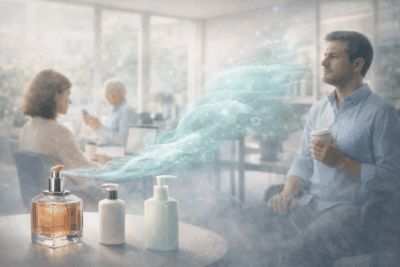
Many people assume that washing with a scented product, layering deodorant and perfume, or using scented laundry sheets are harmless personal choices. What most people don’t recognize is that these habits release unknown chemicals into shared air and shared spaces. Other people do not get a vote in that exposure, and because we are not told what is in these fragrance blends, there is no reasonable basis to assume they are safe.
Mainstream sources report increasing complaints about fragrance reactions as usage increases. But what often gets missed is this: fragrance itself is legally categorized as a proprietary trade secret, so manufacturers don’t disclose ingredients, and researchers can’t fully evaluate what people are being exposed to if they don’t know what’s in it. Comprehensive safety data on long‑term, everyday exposures is largely absent because ingredients are undisclosed.
Many individuals experience headaches, nausea, dizziness, and respiratory symptoms after exposure to fragranced products. A lot of people never connect the dots because the ingredients are hidden and scented environments are widely accepted as “normal.” When the body is reacting to an exposure that cannot be identified, the experience is often described under the umbrella of Multiple Chemical Sensitivity, or MCS.1 The chemicals causing these reactions are frequently synthetic, undocumented, and unregulated.
Why Fragrance Use Keeps Expanding
When someone repeatedly exposes themselves to strong scents, their sense of smell can become desensitized because sensory receptors adapt to constant stimulation. Our noses evolved to warn us about dangers such as spoiled food, smoke, or toxic chemicals. Constant fragrance exposure can dull that warning system, making it harder for people to notice how strong their own scent has become.
This cycle of desensitization encourages heavier use, creating a feedback loop where individuals apply more fragrance to achieve the same perceived effect, which amplifies chemical exposure to themselves and everyone around them.
What Is “Fragrance,” Really?
Despite their pleasant marketing, these products are not harmless. Some compounds used in fragrance blends, such as volatile organic compounds, or phthalates, which have been linked to endocrine disruption and other health concerns in laboratory settings. The more important point is that consumers usually cannot evaluate what they are being exposed to because the full ingredient list is not disclosed.2,3
We should be asking “what’s in it” far more often when it comes to personal care products. Because what is fragrance? In many cases, only the manufacturer knows.
There is virtually no effective protection requiring full disclosure of fragrance ingredients in the United States. These compounds are commonly shielded as trade secrets, meaning consumers and regulators alike can be kept in the dark about what is actually in these products. When exposure cannot be identified and quantified, safety cannot be confidently claimed.8
Why So Many Headaches?
Fragrance exposure is not contained to the wearer. It disperses through shared air, settles on surfaces, and affects people who never chose to be exposed. This is not an issue of preference. It is involuntary chemical exposure in shared spaces.
One major issue is that “fragrance” can represent thousands of different chemicals, alone or in combination. Pinpointing what a person is reacting to can be nearly impossible when the formula is hidden. For many people, avoidance is the most effective form of self‑protection. But it is not realistically possible to avoid fragrances in public places or at work.
The other day I had an appointment to establish care with a new doctor. After waiting a couple weeks, I showed up early to complete paperwork. When I walked in, the smell was so strong that at first I assumed someone wearing heavy perfume had just passed through. But after 30 minutes, the smell only intensified. I finally asked if the fragrance was always that heavy in their office.
The receptionist, who was clearly not well, replied, “Usually just on Fridays, when the massage therapist is here. It’s her massage oils. I know it’s strong, but there’s nothing we can do about it. And it gives me an awful headache every time.”
It gave her a headache. While I felt bad for the receptionist, I also felt bad for myself. Prolonged exposure meant I would likely have a migraine within a couple hours, and the longer I stayed, the longer the migraine would last. I politely let her know I would be waiting outside.
But outside was no better. The scent was so strong I could still smell it, even standing outdoors.
I considered my options. If I stayed, maybe another room would be less intense and tolerable, but at what risk? If I stayed, I might have to endure this every time I needed care. If I left, I could be charged for an appointment without receiving any actual care.
I went back inside to ask for the restroom, partly to see if the rest of the building was better. It was not. I returned to the receptionist and told her I had to leave, and I did not want to be charged, because I was having an allergic reaction to their “ambiance.” She was understanding, and likely jealous that I had the option to leave. She did not, if she wanted to keep her job.
Even when I opted to buy groceries online, where I only had to drive to a designated pickup spot, I was still hit with heavy fragrance from the grocery clerk loading bags into my car. She insisted she was not wearing perfume, “just lotion.”
Then there are the less obvious exposures. A letter mailed from that doctor’s office arrived smelling strongly of fragranced lotion, enough that I could barely handle the paper and struggled to wash the residue off my hands afterward.
Or when a former boss tried to accommodate me by speaking from ten feet away, as if fragrance stops at an invisible boundary. It’s like having a peeing section in a public swimming pool. Her intentions were good, and I heard plenty of whispers from others that her perfume bothered them too, but I was still the only one who spoke up.
Many people with these sensitivities do not speak up because they are tired, embarrassed, afraid of conflict, or afraid of losing access to work and services. Many people tolerate fragranced environments because they need a paycheck or they need medical care.
You Are Also Exposing Yourself, Not Just Strangers
A little synthetic terpenoid in your cologne or aftershave. Formaldehyde‑releasing compounds in lotion. 1,4‑dioxane contamination in certain detergents. Phthalates in perfume. You might say, “I don’t see those on the label.” Are you sure?
In research on fragranced consumer products, ingredient disclosure has repeatedly been shown to be incomplete. One emissions study of 134 common consumer products identified 1,538 VOC occurrences representing hundreds of distinct VOCs, and fewer than 10 % of potentially hazardous VOCs were listed on any product label.4
More recently, controlled chamber studies continue to show that fragranced personal care products emit VOCs and can contribute to indoor chemistry that forms secondary pollutants and ultrafine particles.5 This matters because people spend most of their lives indoors.
Multiple studies and reviews link cleaning and fragranced product use with indoor air contaminants and respiratory effects, especially for vulnerable populations.6 Surveys consistently find a substantial portion of the population reports adverse effects from fragranced products, and those with chemical sensitivity report higher rates of impacts, including lost workdays and even job loss.1
Bottom line: Fragrance exposure is a public‑health issue, not just a personal annoyance.
When Fragrance Becomes a Legal Issue
This is not theoretical. Many people cannot safely access workplaces or even healthcare environments when fragrance is treated as “normal.” Occupational and policy discussions around MCS describe how scent‑free policies and accommodations can be necessary for some individuals to function and remain employed.7
Individuals with documented fragrance sensitivity or multiple chemical sensitivity have filed complaints and, in some cases, pursued legal action when ongoing exposure interfered with their ability to work, receive medical care, or safely occupy shared spaces. Courts and regulatory bodies have not treated fragrance sensitivity uniformly, but guidance from occupational‑health and disability resources increasingly recognizes that fragrance exposure can rise to the level of a functional impairment.
The Job Accommodation Network (JAN), a service of the U.S. Department of Labor, explicitly recognizes fragrance sensitivity and multiple chemical sensitivity as conditions that may warrant workplace accommodation, including fragrance‑free policies or environmental controls.9
This does not mean every scented product is illegal or that all environments must be fragrance‑free. It does mean that the assumption of fragrance as a harmless personal choice breaks down when real people are excluded from work, healthcare, or public spaces unless exposure is reduced.
Bottom Line
This is not about shaming someone for liking a scent. It is about acknowledging a reality: fragrance often represents undisclosed chemical mixtures, and those mixtures do not stay politely on the wearer. They enter shared air. They settle on shared surfaces. They can trigger symptoms in real people, and the hidden‑ingredient problem makes it difficult to identify and avoid specific triggers.
If full transparency is not coming, then awareness is the only leverage consumers have. The safest “common sense” position is to stop treating unknown chemical exposure as harmless just because it is popular.
For Health,
Tober
References
- Steinemann A. National Prevalence and Effects of Multiple Chemical Sensitivity in the United States. J Occup Environ Med. 2018. PMCID
- Steinemann AC. Fragranced consumer products and undisclosed ingredients. Environ Impact Assess Rev. 2009;29(1):32‑38. PubMed
- Rádis‑Baptista G. Do Synthetic Fragrances in Personal Care and Household Products Impact Indoor Air Quality and Human Health? 2023. PubMed
- Nematollahi N, et al. Volatile chemical emissions from 134 common consumer products. Air Qual Atmos Health. 2019;12:1259‑1265. PubMed
- Wu T, et al. Indoor Emission, Oxidation, and New Particle Formation of Fragranced Personal Care Products. Environ Sci Technol Lett. 2024. ACS
- Salonen H, et al. Cleaning products: Their chemistry, effects on indoor air quality and human health. 2024. PubMed
- Martini A. Multiple Chemical Sensitivity and the Workplace. 2013.
Nature's Complement is a participant in the Amazon Services LLC Associates Program, an affiliate advertising program. If you purchase products on Amazon through any of our affiliate links, we get a small percentage of the transaction, at no extra cost to you. We spend a lot of time writing the articles on this site, and all this information is provided free of charge. When you use our affiliate links, you support the writing you enjoy without necessarily buying our products. (However we would appreciate if you would do that too!) Thank you for helping to support our work, however you choose to do so.
These statements have not been evaluated by the Food and Drug Administration. This information and/or products are not intended to diagnose, treat, cure or prevent any disease.