

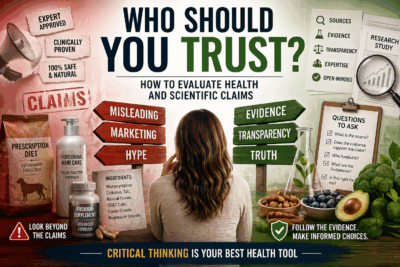
This confusion is not accidental. It is a natural consequence of how information is produced, interpreted, marketed, repeated, and communicated. The real question is not just what to believe, but who to trust.
Key Point: Conflicting information is not unusual in science, but blindly trusting the loudest or most credentialed voice is where problems begin.
What Does “Expert” Actually Mean?
We are often told to “trust the experts.” But what exactly qualifies someone as an expert?
A PhD indicates advanced training in a specific academic field. An MD indicates training in diagnosing and treating patients. These are valuable credentials, but they are not interchangeable, and they are not universal.
A PhD in public health, for example, is not trained to diagnose or prescribe medications. An MD, on the other hand, may not be extensively trained in interpreting complex research data, experimental design, advanced nutrition, environmental chemical exposure, or ingredient-level effects on the skin.
There are also important differences between fields that are often overlooked. A PhD in ecology, microbiology, physics, or public health all represent very different types of training. Some involve hands-on experimental work, often called bench science, while others focus more on population-level data, modeling, policy, or field observation.
These distinctions matter. Someone trained in public health may be highly knowledgeable about population trends and epidemiology, but may not be routinely working with molecular pathways, chemical interactions, or cellular mechanisms. Likewise, a physicist or ecologist may have deep expertise in their own field, but that does not automatically translate to expertise in human biology, toxicology, nutrition, or skin chemistry.
At the same time, individuals trained in laboratory sciences may spend years directly studying biochemical pathways, cellular responses, and mechanisms of action, but may have little training in clinical diagnosis or patient care.
Credentials matter, but they do not automatically mean that a person is an expert in every related topic.
Key Point: “Expert” is not a universal label. It is specific to a field, and applying it outside of that field can be misleading.
The Illusion of Authority
Titles, years of experience, affiliations, and certifications are often used as shortcuts for trust.
Statements like:
- “I’ve been doing this for 20 years.”
- “I was trained by the manufacturer.”
- “I’m certified in this field.”
- “Experts in the industry say this is safe.”
may sound convincing, but they do not tell you whether the conclusions being presented are supported by independent evidence.
Experience can reinforce good understanding, or it can reinforce bad assumptions. Training can be educational, or it can be biased, depending on who provided it and what the goal of that training was.
Key Point: Authority should not be assumed. It should be supported by evidence.
What Does “Expert in the Field” Actually Mean?
The phrase “expert in the field” is often used in marketing and sales, but it is rarely defined.
In many cases, this “expert” is someone who has been trained by a manufacturer or company to understand and promote specific products. While that training may include useful information, it is not the same as independent scientific expertise.
Being trained on how a product works is not the same as understanding all of its potential effects, limitations, risks, or ingredient interactions, especially outside of controlled or ideal conditions.
Professionals in many industries develop real skill and experience in their craft. However, it is important to recognize that product training in these industries does not typically require advanced scientific education. In many cases, the focus is on learning how to use, recommend, and sell products, rather than critically evaluating their ingredients, mechanisms, or long-term effects.
It is not uncommon to hear statements such as, “I’ve been trained by the industry for 20 years,” presented as a form of authority. While experience matters, the source of that training matters just as much. Repeated exposure to the same manufacturer-provided information can reinforce a particular viewpoint without necessarily expanding or challenging it.
This does not mean the individual is uninformed. It means the scope of their training may be narrow and shaped by the priorities of the company providing it.
Key Point: Experience and training are only as reliable as the source, scope, and independence of the information behind them.
When “Expert Advice” Comes From the Beauty Industry
A similar dynamic exists in the hair and beauty industry, where professionals are often trained directly by manufacturers on how to use and recommend specific products.
Hair stylists, estheticians, and other beauty professionals may have real skill and experience. However, much of their product knowledge often comes from brand-specific education, and brand-specific education is designed not only to inform, but also to promote.
These products are often presented as having been “thoroughly tested,” “professionally formulated,” or “safe for sensitive skin.” While that may be true in a limited or controlled sense, those statements rarely tell the full story.
Most cosmetic ingredients are not evaluated in the context of long-term, repeated exposure across diverse populations. Safety assessments may look at individual ingredients in isolation, not necessarily in combination, and not always under real-world conditions of use. In the United States, cosmetic products and ingredients generally do not require FDA premarket approval, with the important exception of certain color additives.1
This creates a gap between how products are presented and how they may actually behave in practice. That gap is where many real-world reactions occur.
For example, a product marketed as “safe for sensitive skin” may still contain ingredients that are known to cause irritation or allergic reactions in certain individuals. If someone has already experienced a reaction to a specific ingredient, no amount of reassurance based on generalized claims should override that direct evidence.
I once had a hairdresser insist that I would not have a reaction to a product because they had been told by “experts in the field” that it was designed for sensitive skin, even though it contained an ingredient I had personally reacted to before.
In that situation, the appeal to authority was being used to override direct experience and known evidence.
Key Point: Product training is not the same as independent safety evaluation, and generalized claims do not override individual reactions.
When “Expert Advice” Comes Through the Manufacturer
Another place this shows up is with products that are recommended through professionals, but where much of the product education comes from the manufacturer. Veterinary “prescription” diets are one example.
Many veterinarians genuinely want to help their patients, and many rely on the training and information they are given by pet food companies. That does not mean the consumer should stop asking questions. A product can be recommended by a professional and still deserve scrutiny, especially when it is expensive, heavily marketed, and made by a company with a financial interest in the recommendation.
The term “prescription diet” can also be confusing. These products are food, not medication in the usual sense. FDA guidance recognizes that dog and cat foods marketed to diagnose, cure, mitigate, treat, or prevent disease can raise drug-approval issues, but FDA also describes circumstances where it may exercise enforcement discretion for these diets when they are used under veterinary supervision.2
That distinction matters. If a food is being treated like a medical intervention, then consumers have every right to ask what makes it different, what evidence supports it, whether there are alternatives, and whether the ingredient list matches the health claims being made.
For example, if a veterinarian recommends a costly therapeutic diet, it is reasonable to ask:
- What specific condition is this food intended to support?
- What ingredient or nutrient change makes it different?
- Is there published evidence for this specific product, or just the general dietary approach?
- Are there lower-cost alternatives with similar nutrient targets?
- Does the ingredient list include corn, soy, wheat, by-products, or other ingredients the owner is trying to avoid?
This is not about attacking veterinarians. It is about recognizing that even professionals can be influenced by manufacturer education, product availability, habit, and trust in company-provided claims.
Key Point: A professional recommendation can be valuable, but it should not end the conversation. If a product is being presented as necessary, the evidence and ingredient list should be open to scrutiny.
When “Expert Formulated” Becomes a Marketing Tool
The supplement industry provides another example. Products are often marketed as being “expert formulated” or “science-backed,” yet the level of evidence supporting these claims can vary widely.
In many cases, individual ingredients may have some supporting research, but the specific formulation, dosage, combination, or final product may not have been independently tested.
This creates a situation where scientific language is used to build credibility, even when the actual evidence for the final product is limited.
Another layer that is often overlooked is the full ingredient list. Many supplements are marketed based on their primary active ingredient, such as vitamin D, magnesium, or a specific botanical, but contain additional components that receive far less attention.
These can include fillers, flow agents, colorings, flavorings, and “natural flavors.” While some of these serve manufacturing purposes, others raise reasonable questions about necessity and potential long-term exposure.
In one case, I noticed talc listed in the ingredients of a supplement I was reviewing. When I asked a representative about it, they appeared surprised and had to turn the bottle around to confirm it was actually there.
That moment stood out, not because of one specific ingredient alone, but because it highlighted a broader issue: someone responsible for recommending or selling the product was not fully aware of what it contained.
This is not uncommon. Products are often marketed and recommended based on their headline ingredients, while the rest of the formulation receives very little scrutiny.
Dietary supplement labeling also operates differently than drug approval. Structure/function claims can describe how a nutrient or dietary ingredient affects the normal structure or function of the body, but these claims are not the same as proving that the product diagnoses, treats, cures, or prevents disease.3,4
Key Point: If someone is recommending a product but cannot confidently explain its full ingredient list, that recommendation should be taken with caution.
When “Nutrition Advice” Is Shaped by Industry
The same patterns can be seen in human nutrition. Dietary recommendations are influenced not only by scientific research, but also by industry funding, historical guidelines, institutional momentum, and public messaging.
It is not uncommon for certain foods or ingredients to be labeled as “healthy” or “unhealthy” based on simplified interpretations of complex data. Over time, these interpretations can become widely accepted, even when the underlying evidence is mixed, incomplete, or evolving.
In some cases, research supporting specific dietary patterns, ingredients, or product categories may be funded by the very industries that benefit from those conclusions. This does not automatically invalidate the findings, but it does mean the findings deserve careful review.
Consumers are often presented with confident recommendations, but rarely with the full context, limitations, funding disclosures, or competing interpretations of the data.
Key Point: Nutritional advice is often influenced by a combination of science, funding, and historical precedent, not science alone.
The Data Problem
One of the most common problems is not outright false information, but misrepresentation of real data.
You may see an article confidently stating:
- “Studies show…”
- “Research proves…”
- “Science confirms…”
But when you go back and read the actual study, the conclusions often do not match the claims.
This can happen in several ways:
- Cherry-picking favorable results
- Ignoring limitations of the study
- Overstating weak or preliminary findings
- Confusing correlation with causation
- Applying population-level data to individual situations
- Ignoring dose, exposure route, or real-world conditions
The most dangerous misinformation is not always fabricated. Sometimes it is real data that has been interpreted incorrectly, exaggerated, or presented without context.
Key Point: The claim “studies show” means very little unless the study actually supports the claim being made.
Follow the Money
Another important question is: who paid for the information?
Research funding, sponsorships, consulting relationships, brand partnerships, and industry relationships can influence:
- what gets studied
- what does not get studied
- how results are interpreted
- how findings are presented to the public
- which experts are promoted as voices of authority
This does not automatically invalidate the information, but it should raise your level of scrutiny.
Transparency matters. Disclosures matter. And when those disclosures are missing, that matters too.
Key Point: Financial incentives do not automatically invalidate research, but they should always be considered when evaluating it.
Behavior Is a Clue
How someone presents information can tell you as much as what they are saying.
Pay attention to patterns like:
- Attacking individuals instead of addressing arguments
- Using emotional pressure instead of evidence
- Speaking in absolute terms with no uncertainty
- Dismissing opposing views without explanation
- Using credentials as a shield against legitimate questions
- Refusing to say “I do not know”
People who are truly grounded in science usually understand that data can be incomplete, uncertain, or evolving. They may have a strong opinion, but they should still be able to explain the evidence, the limitations, and where uncertainty remains.
When someone becomes argumentative instead of acknowledging nuance, or when they use their credentials to shut down questions rather than answer them, that is worth noticing.
Another common pattern is dismissing individual experiences when they conflict with generalized claims, rather than investigating why those differences might exist.
Key Point: People who rely on attacks, certainty, or credentials instead of evidence are often signaling that their argument may not be as strong as it sounds.
So Who Should You Trust?
Instead of looking for a specific type of person to trust, look for specific behaviors.
Trustworthy sources tend to:
- Provide sources, and those sources actually support their claims
- Acknowledge uncertainty and limitations
- Explain how they reached their conclusions
- Distinguish between evidence, interpretation, and opinion
- Disclose conflicts of interest
- Stay within their area of expertise
- Revise their position when better evidence becomes available
No one gets everything right. What matters is whether someone is committed to following the evidence, even when that evidence is inconvenient.
Key Point: Trust is built on transparency, consistency, humility, and a willingness to follow evidence, not on titles alone.
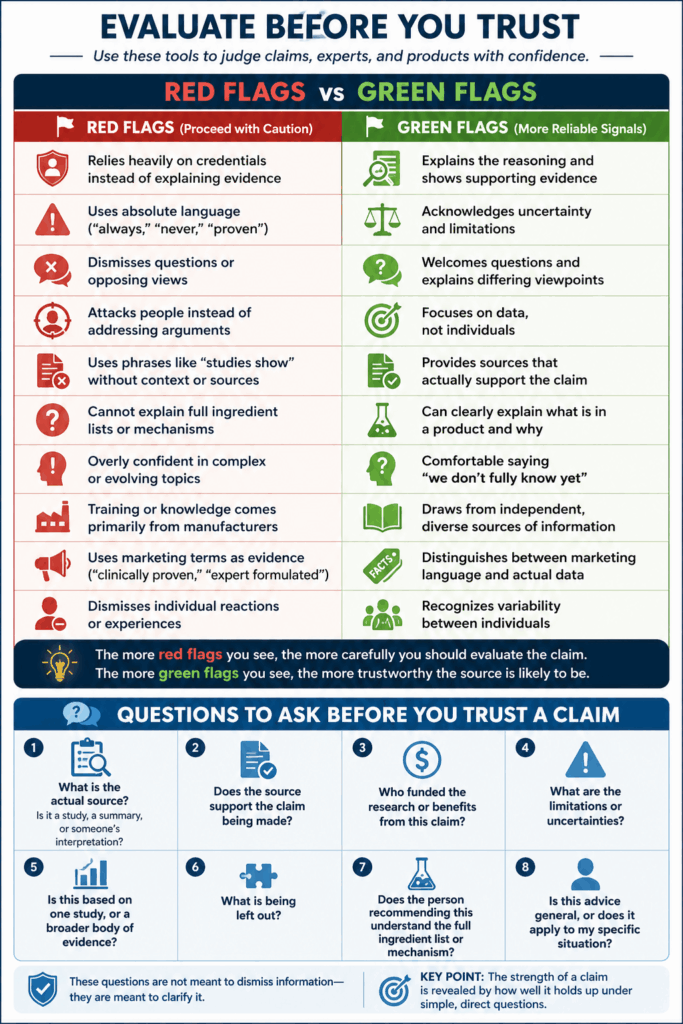
Red Flags vs Green Flags: How to Evaluate Information Quickly
When you are faced with conflicting information, it is not always practical to dig through full research papers in the moment. However, there are patterns that can help you quickly assess whether a claim deserves more trust—or more scrutiny.
You do not need to memorize everything in this article—but recognizing these patterns can dramatically improve your ability to evaluate information.
| Red Flags (Proceed with Caution) | Green Flags (More Reliable Signals) |
|---|---|
| Relies heavily on credentials instead of explaining evidence | Explains the reasoning and shows supporting evidence |
| Uses absolute language (“always,” “never,” “proven”) | Acknowledges uncertainty and limitations |
| Dismisses questions or opposing views | Welcomes questions and explains differing viewpoints |
| Attacks people instead of addressing arguments | Focuses on data, not individuals |
| Uses phrases like “studies show” without context or sources | Provides sources that actually support the claim |
| Cannot explain full ingredient lists or mechanisms | Can clearly explain what is in a product and why |
| Overly confident in complex or evolving topics | Comfortable saying “we don’t fully know yet” |
| Training or knowledge comes primarily from manufacturers | Draws from independent, diverse sources of information |
| Uses marketing terms as evidence (“clinically proven,” “expert formulated”) | Distinguishes between marketing language and actual data |
| Dismisses individual reactions or experiences | Recognizes variability between individuals |
Key Point: Red flags do not automatically mean something is wrong—but the more you see, the more carefully you should evaluate the claim.
Key Point: Green flags do not guarantee something is correct—but they are strong indicators of a more trustworthy and evidence-based approach.
Questions to Ask Before You Trust a Claim
If something sounds convincing, but you are not sure whether to trust it, a few simple questions can quickly reveal how strong the claim really is.
- What is the actual source? (Is it a study, a summary, or someone’s interpretation?)
- Does the source support the claim being made?
- Who funded the research or benefits from this claim?
- What are the limitations or uncertainties?
- Is this based on one study, or a broader body of evidence?
- What is being left out?
- Does the person recommending this understand the full ingredient list or mechanism?
- Is this advice general, or does it apply to my specific situation?
These questions are not meant to dismiss information—they are meant to clarify it.
Key Point: The strength of a claim is revealed by how well it holds up under simple, direct questions.
The Reality
There is no shortcut here.
There is no single expert you can follow blindly. There is no single source that is always correct. There is no credential that guarantees accuracy. There is no manufacturer training program that replaces independent evidence.
At some point, it comes back to you.
Reading the data. Checking the sources. Looking for disclosures. Reading the ingredient list. Paying attention to how claims are made, not just what is being claimed.
That may feel frustrating, but it is also empowering. Once you learn how to evaluate information, marketing becomes easier to spot, authority becomes easier to question, and evidence becomes easier to recognize.
If you only remember one thing: Credentials can guide you, but they should never replace critical thinking. Always follow the evidence, not the title.
For Health,
Tober
References:
1. U.S. Food and Drug Administration. FDA Authority Over Cosmetics: How Cosmetics Are Not FDA-Approved, but Are FDA-Regulated. Updated November 18, 2025. Accessed April 25, 2026. https://www.fda.gov/cosmetics/cosmetics-laws-regulations/fda-authority-over-cosmetics-how-cosmetics-are-not-fda-approved-are-fda-regulated
2. U.S. Food and Drug Administration. CPG Sec. 690.150 Labeling and Marketing of Dog and Cat Food Diets Intended to Diagnose, Cure, Mitigate, Treat, or Prevent Diseases. Accessed April 25, 2026. https://www.fda.gov/regulatory-information/search-fda-guidance-documents/cpg-sec-690150-labeling-and-marketing-dog-and-cat-food-diets-intended-diagnose-cure-mitigate-treat
3. U.S. Food and Drug Administration. Structure/Function Claims. Updated March 28, 2024. Accessed April 25, 2026. https://www.fda.gov/food/nutrition-food-labeling-and-critical-foods/structurefunction-claims
4. U.S. Food and Drug Administration. Notifications for Structure/Function and Related Claims in Dietary Supplement Labeling. Updated February 9, 2023. Accessed April 25, 2026. https://www.fda.gov/food/information-industry-dietary-supplements/notifications-structurefunction-and-related-claims-dietary-supplement-labeling
Nature's Complement is a participant in the Amazon Services LLC Associates Program, an affiliate advertising program. If you purchase products on Amazon through any of our affiliate links, we get a small percentage of the transaction, at no extra cost to you. We spend a lot of time writing the articles on this site, and all this information is provided free of charge. When you use our affiliate links, you support the writing you enjoy without necessarily buying our products. (However we would appreciate if you would do that too!) Thank you for helping to support our work, however you choose to do so.
These statements have not been evaluated by the Food and Drug Administration. This information and/or products are not intended to diagnose, treat, cure or prevent any disease.