


Let’s be honest about something: our personal care habits didn’t develop in a vacuum. They were either passed down to us by our parents, or shaped by what we saw—television, advertisements, magazines, and now social media. Somewhere along the way, we were shown what “normal” looks like.
Last Updated: Apr 2026
And over time, that definition of normal has shifted. Even for those of us who were taught simple, effective ways to care for our skin and hair, many of those habits were replaced by something easier—products designed to deliver fast, consistent results with minimal effort.But convenience always comes with a tradeoff. And in this case, that tradeoff is often hidden.
Modern personal care products are designed to behave in very specific ways. They should be thick, smooth, colorful, strongly scented, and feel the same every single time you use them.
Those expectations didn’t happen by accident. They were engineered.
To meet those expectations, manufacturers rely on synthetic ingredients—thickeners, stabilizers, artificial fragrances, preservatives, and other compounds that alter how a product looks, feels, and performs.
Over time, we’ve come to associate those characteristics with quality.
So when a product doesn’t behave that way, it feels wrong—even if it’s actually closer to what the product was originally meant to be.
There are practical reasons why conventional products are formulated the way they are.
Cost is one factor—synthetic fillers and additives are often cheaper. Appearance is another—color and texture influence perception. Scent plays a major role, as people often judge quality based on smell alone. Consistency matters too, because once someone trusts a product, they expect it to behave the same way every time.
Then there are technical reasons. Oils can go rancid. Water-based products can spoil. Products need to remain stable on shelves for months or years.
So manufacturers solve these problems with chemistry.
The issue is not that chemistry exists—the issue is how it is used, how much is used, and how little attention is sometimes given to long-term exposure.
Many people assume that if a product is sold in stores, it has been thoroughly tested for long-term safety. In reality, cosmetic regulation in the United States is relatively limited compared to other industries1.
This has allowed a wide range of ingredients to be used in personal care products, often without comprehensive evaluation of long-term exposure or combination effects.
At the same time, daily exposure adds up. Studies have estimated that individuals may be exposed to dozens of different ingredients each day through routine product use2.
And yet, this has become normal.
When you remove many of the synthetic additives used to create that “expected” experience, something interesting happens.
The products change.
They may be thinner. They may vary slightly in color. They may not foam as much. The scent may be more subtle, or different than what you’re used to.
And that’s often where people decide something is wrong.
But in many cases, what they are seeing is not a flaw—it’s the absence of unnecessary modification.
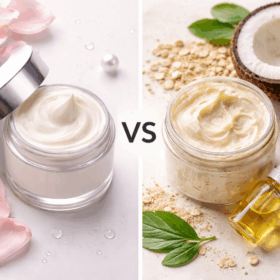
Take something as simple as dish soap. Many commercial versions are thick, brightly colored, and heavily fragranced. Those characteristics are not required for cleaning—they are added to meet expectations.
A more natural formulation may be thinner, less colorful, and produce fewer bubbles. That doesn’t mean it’s less effective—it means it hasn’t been engineered to create a specific sensory experience.
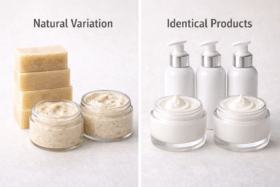
The same applies to creams and lotions. When oils and water are combined without heavy synthetic stabilization, the product may have a shorter shelf life and require more careful handling. Natural variation in color can occur depending on the ingredients used.
These are not defects. They are characteristics of real materials.
One of the biggest challenges when switching to more natural products is separating performance from perception.
Foam does not equal cleaning power. Strong fragrance does not equal effectiveness. Thick texture does not equal quality.
These are learned associations.
When those cues are removed, it can feel like the product isn’t working—even when it is.
Switching to real, minimally processed personal care products requires a shift—not just in what you use, but in how you evaluate it.
You may need to use less product, or apply it differently. You may need to store it differently. You may need to adjust expectations around scent, texture, and appearance.
That adjustment period is real. And for many people, it’s the hardest part.
There is also the question of cost.
When synthetic fillers are removed, what remains are the actual functional ingredients—and those tend to be more expensive.
This often results in smaller product sizes at a higher price point. But those products are also typically more concentrated, meaning less is needed per use.
The value is not always obvious at first glance, especially when compared to large, inexpensive products built around fillers.
This is the real question.
Are you ready to use products that don’t look, feel, or behave the way you’ve been conditioned to expect?
Are you willing to learn how to use them properly? To read ingredient labels? To accept variability instead of perfect consistency?
Because switching to real, all-natural products is not just a purchase—it’s a change in mindset.
Over time, something interesting happens.
Your expectations adjust. Your senses recalibrate. What once felt “normal” begins to feel artificial, and what once felt unfamiliar begins to make sense.
And more importantly, you gain a clearer understanding of what you’re actually putting on your body.
That awareness alone has value.
Because in the end, the goal isn’t perfection—it’s making more informed decisions over time.
For Health,
Tober
References:
1. U.S. Food and Drug Administration. Cosmetics Laws & Regulations. https://www.fda.gov/cosmetics/cosmetics-laws-regulations
2. Environmental Working Group. Exposures Add Up—Survey Results. 2004.
3. Matta MK, et al. Effect of Sunscreen Application on Plasma Concentration of Sunscreen Active Ingredients. JAMA. 2019;321(21):2082–2091.
Nature's Complement is a participant in the Amazon Services LLC Associates Program, an affiliate advertising program. If you purchase products on Amazon through any of our affiliate links, we get a small percentage of the transaction, at no extra cost to you. We spend a lot of time writing the articles on this site, and all this information is provided free of charge. When you use our affiliate links, you support the writing you enjoy without necessarily buying our products. (However we would appreciate if you would do that too!) Thank you for helping to support our work, however you choose to do so.
These statements have not been evaluated by the Food and Drug Administration. This information and/or products are not intended to diagnose, treat, cure or prevent any disease.