

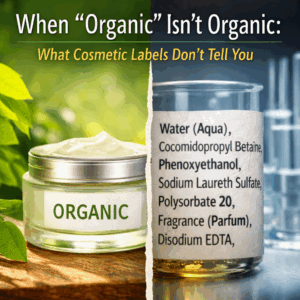
A lot of trust is placed in the words printed on the front of personal care products. Words like “organic,” “natural,” and “clean” are meant to signal safety, quality, and integrity. But what most consumers don’t realize is that, in many cases, those words have little to no regulatory meaning in cosmetics.
Last Updated: Apr 2026
This isn’t speculation—it has already been demonstrated in real-world enforcement actions. In 2019, the Federal Trade Commission (FTC) took action against a skincare company for allegedly misrepresenting its products as “organic” and “all natural,” when in fact many of those products either contained non-organic ingredients or no organic ingredients at all.1 The case highlighted a larger issue: marketing language in the personal care industry is often not aligned with regulatory definitions.
So what does “organic” actually mean? The answer depends entirely on context.
USDA Organic vs. Cosmetic “Organic” Claims
In the United States, the term “organic” is strictly defined—but only within the scope of agriculture and food production under the United States Department of Agriculture (USDA) National Organic Program (NOP).2 For a product to carry an official USDA Organic seal, it must meet specific criteria, including:
- At least 95% organically produced ingredients (excluding water and salt)
- Certification by a USDA-accredited certifying agent
- Compliance with approved substances lists and processing standards
However, most personal care products do not fall under USDA organic certification requirements. The Food and Drug Administration (FDA), which regulates cosmetics, does not define or enforce the term “organic” in the same way.3 This creates a gap where products can use the word “organic” in marketing without meeting USDA standards—so long as they are not falsely claiming USDA certification.
The Problem with Front Label Marketing
The front of a product label is designed to sell. It is not designed to inform.
Terms such as:
- “Organic”
- “All Natural”
- “Non-Toxic”
- “Clean Beauty”
are largely unregulated in cosmetics and can be used without standardized definitions.3,4 This means two products sitting side by side on a shelf—both labeled “organic”—may have completely different ingredient compositions and safety profiles.
In some cases, a product may contain only a small amount of an organic ingredient while prominently displaying the word “organic” on the front label. In other cases, the term may be used purely as a branding strategy, with no meaningful connection to certified organic sourcing.
The Ingredient List: Where the Truth Lives
If the front label is marketing, the ingredient list is disclosure.
Under U.S. law, cosmetic products are required to list ingredients in descending order of predominance.5 This list—often printed in small text on the back or side of the product—is the most reliable source of information available to consumers.
Reading the ingredient list can reveal:
- Whether organic ingredients are actually present—and in what relative amount
- The presence of synthetic surfactants, preservatives, or fragrances
- Whether “botanical” or “plant-based” claims reflect meaningful formulation or minimal inclusion
It is also important to understand that ingredient names follow standardized nomenclature (INCI—International Nomenclature of Cosmetic Ingredients), which can make them difficult to interpret without additional research.6
How to Research What’s Really in Your Products
If you want to understand what you’re putting on your skin, you don’t need to rely on marketing claims—you can verify it yourself. Here’s a simple way to do it:
-
- Start with the ingredient list, not the front label.
The front is designed to sell. The ingredient list is required to disclose what’s actually in the product.
- Start with the ingredient list, not the front label.
-
- Look up unfamiliar ingredients using scientific sources.
Search the ingredient name along with terms like “toxicity,” “dermal exposure,” or “safety.” Prioritize peer-reviewed research over blogs or marketing websites.
- Look up unfamiliar ingredients using scientific sources.
-
- Use PubMed for primary research.
PubMed (pubmed.ncbi.nlm.nih.gov) provides access to published scientific studies. Even reading abstracts can give valuable insight into how an ingredient behaves biologically.
- Use PubMed for primary research.
-
- Check multiple sources—not just one.
Some information online is influenced by manufacturers or marketing groups. Cross-referencing helps filter out bias.
- Check multiple sources—not just one.
-
- Understand concentration matters.
An ingredient listed near the top of the list is present in higher amounts than one listed at the bottom. This can significantly impact safety and effectiveness.
- Understand concentration matters.
-
- Be cautious with vague terms like “fragrance.”
“Fragrance” can represent dozens or even hundreds of undisclosed chemicals, as it is often protected as a trade secret.
- Be cautious with vague terms like “fragrance.”
- Watch for “highlight ingredients.”
Just because an ingredient is featured on the front label does not mean it is present in a meaningful amount.
The more you practice this process, the easier it becomes. Over time, you’ll start to recognize patterns—and you’ll be able to make informed decisions based on evidence, not marketing.
Why This Matters
The lack of standardized definitions for commonly used marketing terms creates an environment where perception can diverge significantly from reality. Consumers may believe they are purchasing products that meet a certain standard—organic, natural, or safe—when those terms may not reflect any enforceable criteria.
This does not mean that all products using these terms are misleading. It does mean that the burden of verification often falls on the consumer.
Understanding the difference between certified standards (such as USDA Organic) and unregulated marketing language is a critical first step. The next step is learning to look beyond the front label and evaluate what is actually in the product.
Because in the end, the safety and quality of a product are not determined by the words printed on the front of the bottle—but by the ingredients listed on the back.
For Health,
Rob
References:
1. Federal Trade Commission. Truly Organic, Inc. (Alleged Misrepresentation of Organic Claims). 2019. Available at: https://www.ftc.gov/news-events/press-releases/2019/09/truly-organic-ftc-says-no-alleges-retailer-misled-consumers-about
2. United States Department of Agriculture (USDA). National Organic Program (NOP): Labeling Standards. Available at: https://www.ams.usda.gov/rules-regulations/organic/labeling
3. U.S. Food and Drug Administration (FDA). Cosmetics Labeling Guide. Available at: https://www.fda.gov/cosmetics/cosmetics-labeling-regulations/cosmetics-labeling-guide
4. U.S. Food and Drug Administration (FDA). “Organic” Cosmetics. Available at: https://www.fda.gov/cosmetics/cosmetics-labeling-claims/organic-cosmetics
5. U.S. Food and Drug Administration (FDA). Ingredient Labeling of Cosmetics. Available at: https://www.fda.gov/cosmetics/cosmetics-labeling-regulations/ingredient-labeling-cosmetics
6. Personal Care Products Council. International Nomenclature of Cosmetic Ingredients (INCI). Available at: https://www.personalcarecouncil.org/resources/inci/
Nature's Complement is a participant in the Amazon Services LLC Associates Program, an affiliate advertising program. If you purchase products on Amazon through any of our affiliate links, we get a small percentage of the transaction, at no extra cost to you. We spend a lot of time writing the articles on this site, and all this information is provided free of charge. When you use our affiliate links, you support the writing you enjoy without necessarily buying our products. (However we would appreciate if you would do that too!) Thank you for helping to support our work, however you choose to do so.
These statements have not been evaluated by the Food and Drug Administration. This information and/or products are not intended to diagnose, treat, cure or prevent any disease.