

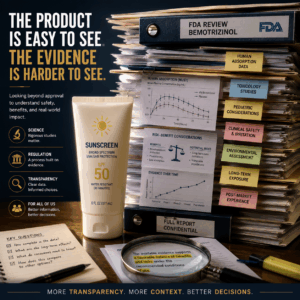
After more than two decades without a new sunscreen ingredient approval in the United States, the FDA has approved Bemotrizinol for use in sunscreen products. Already used internationally for years, the ingredient is being promoted for its broad-spectrum UV protection, photostability, and low levels of skin absorption.1 But what does the evidence actually show, and what questions remain unanswered?
On paper, it seems to address several limitations of older sunscreen ingredients and may offer formulators greater flexibility in creating effective, cosmetically appealing products.
But does that make it the perfect sunscreen ingredient?
Before we rush to declare it a breakthrough, it is worth taking a closer look at what the FDA actually reviewed, what the studies found, and what questions still remain.
Is Bemotrizinol truly safer than previous sunscreen ingredients, or is it simply the latest example of an ingredient whose benefits are being highlighted while its limitations receive less attention? And what should parents know before applying products containing this ingredient to children as young as six months old?
What Is Bemotrizinol?
Before examining the safety data, it helps to understand what Bemotrizinol actually is. Bemotrizinol, also known as BEMT or by the trade name Tinosorb S, is a synthetic organic ultraviolet (UV) filter designed to absorb both UVA and UVB radiation.1 Chemically, it belongs to a class of compounds known as triazines and was specifically engineered to remain stable when exposed to sunlight, a characteristic known as photostability.
This is significant because some sunscreen ingredients can break down during sun exposure, reducing their effectiveness over time. Bemotrizinol has been used in Europe and many other countries for more than two decades, where it gained popularity for its broad-spectrum protection and ability to help stabilize other sunscreen ingredients in a formulation.2
Unlike zinc oxide, which is a mineral, Bemotrizinol is a synthetic organic molecule. It is manufactured through multi-step chemical synthesis involving triazine chemistry and aromatic organic intermediates. That does not automatically make it harmful, but it does mean it is part of the broader discussion about synthetic chemical manufacturing, ingredient transparency, and environmental persistence.

Why Was It Reviewed by the FDA?
The FDA did not randomly select Bemotrizinol for review. The review occurred because DSM Nutritional Products LLC submitted a formal Over-the-Counter Monograph Order Request asking the FDA to add Bemotrizinol to the sunscreen monograph at concentrations up to 6%.1 In other words, the manufacturer seeking approval submitted the data package, and the FDA reviewed that evidence.
This is an important ditinction. The FDA generally does not conduct the studies itself. Instead, it evaluates studies submitted by the company requesting approval. This is standard practice for FDA-regulated products, but it also means consumers should understand where the data originated and how much of it has been independently replicated.
Why the Excitement?
Much of the enthusiasm surrounding Bemotrizinol stems from several characteristics that appear to address longstanding challenges with sunscreen formulation. Unlike some older sunscreen ingredients that primarily absorb either UVA or UVB radiation, Bemotrizinol provides broad-spectrum coverage across both ranges. It is also highly photostable, meaning it resistsBut what does the evidence actually show, and what questions remain unanswered? breaking down when exposed to sunlight. This not only helps maintain protection throughout sun exposure but can also improve the stability of other sunscreen ingredients used alongside it.2
Another factor driving interest is its reportedly low level of skin absorption. In contrast to some sunscreen ingredients that have raised concerns after being detected in human blood following normal use, Bemotrizinol appears to penetrate the skin to a much lesser extent.3 Combined with more than two decades of use in Europe and other regions, these characteristics have led many experts to view the ingredient as a potentially important advancement in sunscreen technology.
However, “promising” is not the same as “perfect.” While the FDA ultimately concluded that Bemotrizinol met the requirements for approval, approval does not mean the ingredient was found to be completely risk-free. Rather, it means the agency determined that the available evidence supports a favorable balance of benefits and risks under the conditions for which it is intended to be used.1
What Did the FDA Actually Review?
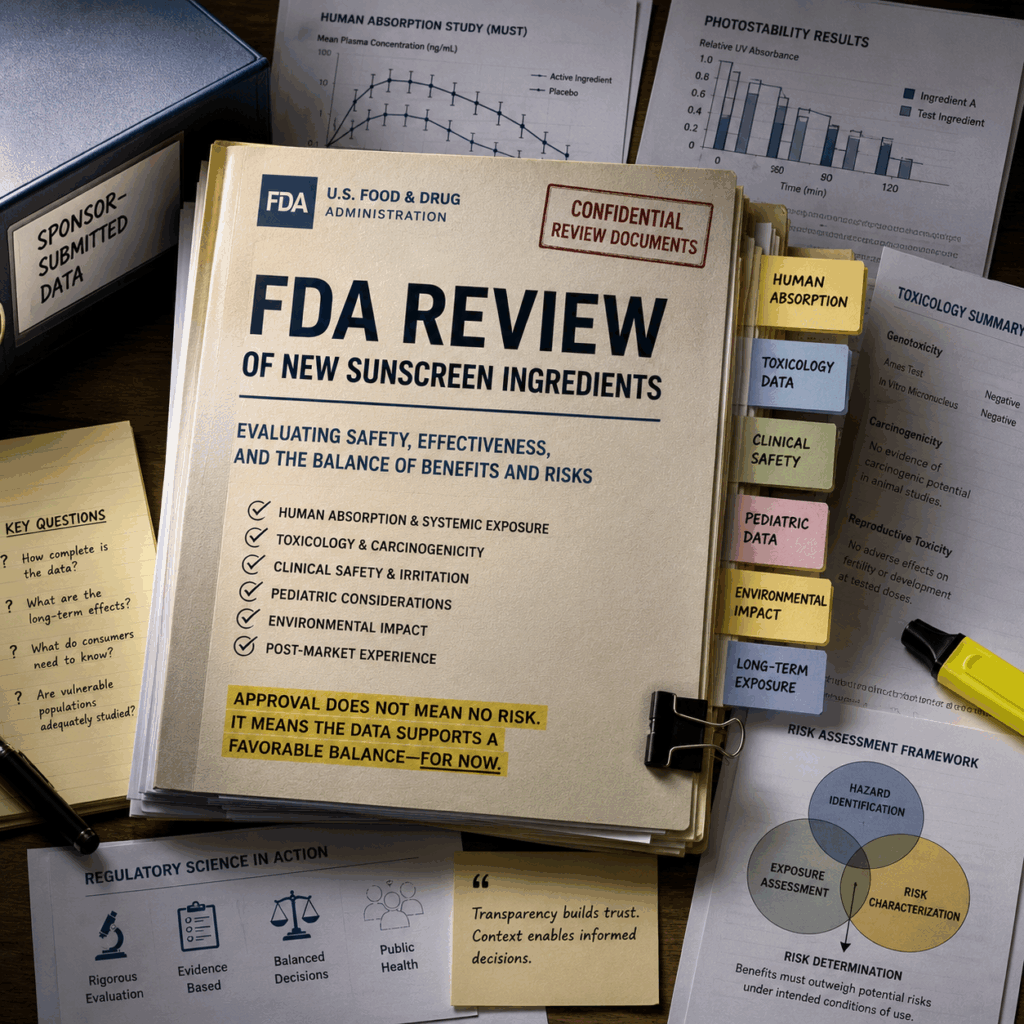
According to the FDA review documents, the agency evaluated multiple categories of evidence, including human absorption studies, toxicology studies, clinical safety data, irritation and sensitization studies, manufacturing information, impurity specifications, environmental assessment data, and years of international post-market experience.1
That sounds reassuring, and in many ways it is. But keep reading, because the details matter.
Human Absorption: Low Does Not Mean None
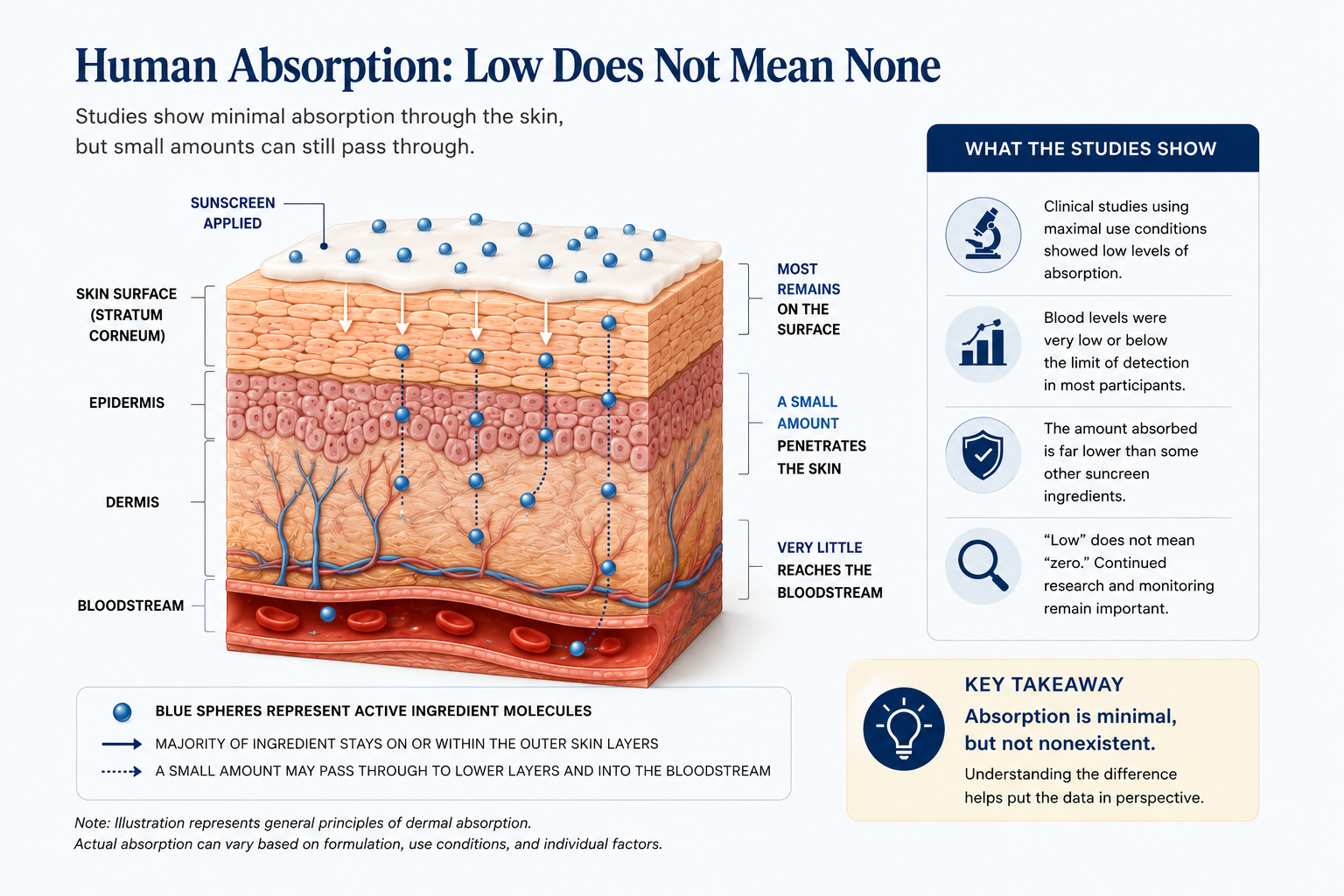
One of the FDA’s biggest concerns in recent sunscreen reviews has been whether active ingredients enter the bloodstream. For Bemotrizinol, the sponsor conducted a Maximal Usage Trial (MUsT), which is designed to simulate heavy real-world use. In the pivotal study, 162 healthy adults applied sunscreen containing 6% Bemotrizinol four times per day for four consecutive days over approximately 75% of body surface area.3
The study did not show that Bemotrizinol stays completely outside the body. It showed that systemic absorption was generally low, but measurable blood concentrations were detected in some participants. Of 3,722 plasma samples analyzed, 31.4% had quantifiable Bemotrizinol concentrations, while 68.6% were below the limit of quantification. Most measurable samples were between 0.1 and 0.5 ng/mL, and 3% of total samples were above 0.5 ng/mL.4
Additionally, 68 of the 162 subjects, or 42%, had at least one sample at or above 0.5 ng/mL. FDA reviewers described the absorption as sporadic and low overall, but they also noted four unusually high samples above 5 ng/mL, with values of 10.5, 13.0, 16.1, and 17.4 ng/mL. These were considered outliers because they did not follow a clear pattern in the samples before or after those time points.4
This distinction matters because marketing language can easily become misleading. “Low absorption” may be interpreted by consumers as “no absorption,” but the FDA-reviewed human study showed that some absorption did occur. The scientific question is not whether the ingredient can enter the bloodstream. It can. The question is whether the amount that enters is biologically meaningful.
What Happens After It Enters the Bloodstream?
This is one of the questions that remains less clearly answered. The FDA determined that systemic exposure was low enough to support approval, but relatively little human research has focused on the long-term biological significance of repeated low-level circulating concentrations. In other words, regulators addressed whether the measured exposure appeared low enough to be acceptable, not whether decades of repeated exposure have been exhaustively studied in every population and under every possible condition of use.
This does not mean that harm is occurring. It means the available evidence answers some questions better than others. The FDA reviewed toxicology studies and did not identify major carcinogenicity concerns, clear endocrine-disrupting effects at expected exposure levels, or reproductive and developmental toxicity that would prevent approval.1 But absence of an obvious safety signal is not the same thing as proving every possible long-term effect is impossible.
Toxicology: What Did the Data Show?
The FDA reviewed standard toxicology testing, including acute toxicity, repeated-dose toxicity, dermal toxicity, organ toxicity, genotoxicity, carcinogenicity, and reproductive and developmental toxicity.1 These studies are designed to look for obvious signs of harm, including DNA damage, mutation potential, organ effects, tumor formation, fertility concerns, pregnancy effects, and fetal development concerns.
The FDA concluded that the available toxicology data did not show an unacceptable safety risk at the expected exposure levels from sunscreen use. Long-term animal studies did not demonstrate a carcinogenic risk that would preclude approval, and reproductive and developmental studies did not show toxicity at expected exposure levels.1
That is reassuring, but it is not the same as saying the ingredient has been proven harmless under all possible circumstances. Toxicology studies help define safety margins. They do not prove that rare effects, subtle effects, or lifetime exposure questions have been completely eliminated.
Who Paid for the Studies?
From the FDA review documents, the core data package was submitted by the sponsor seeking approval. That sponsor was the company requesting that Bemotrizinol be added to the U.S. sunscreen monograph.1 This is not unusual. Most FDA approvals rely heavily on data generated or commissioned by the applicant. FDA scientists then review the submitted studies, methods, results, and conclusions.
This does not automatically invalidate the studies. However, it does mean the majority of the evidence package was generated by a party with a financial interest in the outcome. That is why independent replication and continued post-market monitoring remain important.
Approval Does Not Mean Complete Transparency
An often-overlooked aspect of regulatory approval is the difference between a publicly known ingredient and a publicly available data package. Bemotrizinol itself is not a secret. Its chemical structure is known, and researchers around the world can study its absorption, toxicity, endocrine activity, and environmental behavior.
However, portions of the information submitted to the FDA, including certain manufacturing details, impurity specifications, quality-control procedures, and other proprietary data, are not fully disclosed to the public because they are considered confidential business information.1 As a result, consumers and independent scientists can evaluate much of the available evidence, but they cannot necessarily examine every piece of information reviewed by regulators.
This does not mean the ingredient is unsafe or that the approval process was flawed. Rather, it highlights a reality of modern regulation: regulatory decisions are often based on a combination of publicly available science and proprietary information that cannot be independently scrutinized in its entirety.
What About Children?
Bemotrizinol was approved for use in sunscreen products intended for adults and children six months of age and older.5 However, the pivotal human studies submitted to the FDA were conducted in adults, not infants or young children. FDA reviewers specifically noted that pediatric data were limited and that the submitted studies were conducted in populations ages 18 and above.5
The FDA reasoned that additional pediatric maximal-use studies were not necessary because overall absorption was well below the agency’s threshold of concern. Although adverse events were reported during clinical development, the agency concluded that the available dermal safety data did not demonstrate a level of irritation, phototoxicity, or photoallergenicity that would prevent approval. The limited post-market pediatric safety reports were also generally similar to those observed in adults.5
Whether that is sufficient is ultimately a matter of regulatory judgment. But consumers should understand what the approval was, and was not, based on. Approval for infants was not based on large-scale clinical studies conducted specifically in six-month-old children.
Long-Term Exposure: What We Know and What We Don’t
Supporters of Bemotrizinol often point to its more than two decades of international use as evidence of safety, and that history is certainly valuable. A long history of use can help identify common problems and major safety signals. To date, there does not appear to be a large epidemiological signal suggesting widespread human health problems attributable to Bemotrizinol after decades of use in other countries.
However, real-world use and controlled scientific study are not the same thing. While regulators reviewed long-term animal toxicology studies and decades of post-market experience, there are relatively few controlled human studies specifically designed to evaluate the effects of repeated exposure over decades of use.
This does not mean such effects are occurring, nor does it imply that the ingredient is unsafe. Rather, it reflects a practical reality of science: questions involving lifetime exposure often take a lifetime to answer. As additional years of use accumulate and more research is conducted, our understanding of Bemotrizinol’s long-term safety profile will continue to evolve.
Environmental Impact: The Other Side of Stability
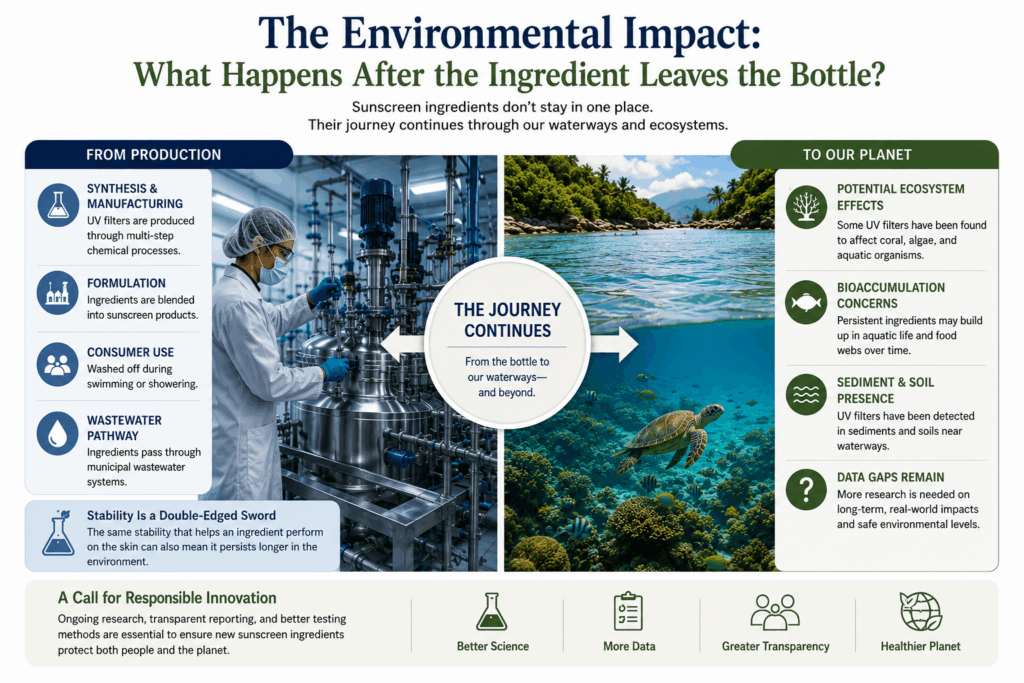
Human safety is only one part of the story. Bemotrizinol was designed to resist degradation in sunlight, which is one reason it performs well as a sunscreen ingredient. But the same characteristic that makes it useful on skin may raise questions once it leaves the bottle.
Unlike mineral sunscreen ingredients such as zinc oxide, Bemotrizinol is produced through industrial chemical synthesis. This allows manufacturers to create a consistent and effective UV filter, but it also means the ingredient carries the environmental footprint associated with chemical manufacturing, including solvents, raw material sourcing, and waste management. Public discussion surrounding sunscreen safety often focuses on what happens after a product is applied to the skin, while far less attention is given to the environmental costs associated with producing the ingredients in the first place, or what happens to the product once it’s washed off the body.
The FDA’s environmental assessment noted that Bemotrizinol is expected to be persistent. In soil studies, degradation was calculated as 0% after 120 days, and the calculated half-life was greater than 1,000 days.6 In simple terms, this means the molecule may remain in certain environmental compartments for a long time.
Because Bemotrizinol is lipophilic and does not dissolve well in water, it is expected to associate with organic matter and sediments rather than remain freely dissolved in water. That means environmental exposure may be concentrated in bottom sediments where organisms such as worms, crustaceans, microorganisms, and larval species live and feed.7
Is It Coral Safe?
This is where consumers should be especially cautious about marketing claims. The term “coral safe” does not have a universally accepted scientific definition. It is often used as a marketing phrase rather than a precise toxicological conclusion.
For ingredients such as oxybenzone, there is a larger body of research examining coral bleaching, coral larval development, and reef toxicity. For Bemotrizinol, the coral-specific literature appears to be much smaller. Based on the information currently available, it would be difficult to honestly claim either that Bemotrizinol is definitely harmful to coral reefs or that it is definitively coral safe.
The more accurate statement is that Bemotrizinol may have a more favorable human absorption profile than some older chemical UV filters, but its environmental persistence raises questions that deserve continued study. “Not known to be highly toxic to coral” is not the same thing as “coral safe.”
So, Is Bemotrizinol Safer or Just Better Regulated?
The answer may be both, but with important qualifications. Based on the evidence reviewed by the FDA, Bemotrizinol appears to offer legitimate advantages as a sunscreen ingredient, including broad-spectrum UV protection, photostability, and relatively low systemic absorption.1 Those are meaningful improvements over some older sunscreen filters.
At the same time, consumers should resist the temptation to confuse “new” with “better” or “FDA approved” with “beyond question.” The FDA reviewed substantial evidence and did not identify a major safety signal that would prevent approval. But some questions remain incompletely answered, including long-term human exposure, pediatric-specific data, environmental persistence, and the degree to which the sponsor-submitted data have been independently replicated.
The issue is not whether Bemotrizinol is perfectly safe or inherently dangerous. The more useful question is whether consumers are being given enough context to understand both the benefits and the remaining uncertainties.
Final Thoughts
The approval of Bemotrizinol is an important development in sunscreen technology, and the available evidence suggests it may offer meaningful benefits compared to some older sunscreen ingredients. However, science advances not by eliminating skepticism, but by continually testing assumptions against evidence.

For now, Bemotrizinol may represent a promising addition to the sunscreen toolbox rather than a reason to abandon approaches with longer histories of use. Consumers should continue to view sunscreen as just one component of sun protection rather than a complete solution. Seeking shade, wearing protective clothing, using hats and sunglasses, and limiting excessive sun exposure remain among the most effective ways to reduce UV damage.
While future research may further strengthen confidence in Bemotrizinol’s safety profile, there is little reason to trade in your zinc oxide, long-sleeved shirts, wide-brimmed hats, and common sense simply because a newly approved ingredient has entered the market.
For Health,
Tober
References
1. U.S. Food and Drug Administration. Final Administrative Order OTC000039: Amending Over-the-Counter Monograph M020: Sunscreen Drug Products for Over-the-Counter Human Use. Issued June 10, 2026.
2. U.S. Food and Drug Administration. Scientific Review Supporting Proposed Administrative Order OTC000039: Bemotrizinol. FDA Center for Drug Evaluation and Research.
3. U.S. Food and Drug Administration. Scientific Review Supporting Proposed Administrative Order OTC000039: Maximal Usage Trial Study Design for Bemotrizinol. FDA Center for Drug Evaluation and Research.
4. U.S. Food and Drug Administration. Scientific Review Supporting Proposed Administrative Order OTC000039: Pharmacokinetic Results from BEMT-001 Part II Pivotal Maximal Usage Trial. FDA Center for Drug Evaluation and Research.
5. U.S. Food and Drug Administration. Scientific Review Supporting Proposed Administrative Order OTC000039: Pediatric Use Discussion. FDA Center for Drug Evaluation and Research.
6. MFG-400105. Bemotrizinol: Revised Environmental Assessment. Submitted in support of OTC000039.
7. U.S. Food and Drug Administration. Environmental Assessment Scientific Review for Bemotrizinol OTC000039. FDA Center for Drug Evaluation and Research.
.
Nature's Complement is a participant in the Amazon Services LLC Associates Program, an affiliate advertising program. If you purchase products on Amazon through any of our affiliate links, we get a small percentage of the transaction, at no extra cost to you. We spend a lot of time writing the articles on this site, and all this information is provided free of charge. When you use our affiliate links, you support the writing you enjoy without necessarily buying our products. (However we would appreciate if you would do that too!) Thank you for helping to support our work, however you choose to do so.
These statements have not been evaluated by the Food and Drug Administration. This information and/or products are not intended to diagnose, treat, cure or prevent any disease.