

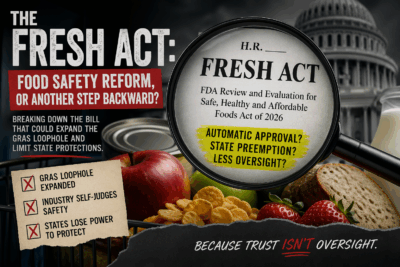
A new food safety bill has been introduced in Congress, and on the surface, it sounds like a step forward. The formal title is the FDA Review and Evaluation for Safe, Healthy and Affordable Foods Act of 2026, being discussed as the “FRESH” Act. Like many bills, the title sounds reassuring. Safe. Healthy. Affordable. Who could argue with that?
But the title of a bill is not the same thing as what the bill actually does. That is why it is important to read the language, not just the press release.
After reviewing the bill text, my concern is that this bill does not appear to close the food chemical safety loopholes consumers have been worried about. In several important ways, it appears to formalize them. And in some places, it may even make it harder for states to take stronger action when the federal government does not.
Key Point: A bill can sound like food safety reform while still shifting more responsibility to industry and limiting stronger state protections.
The Current Problem: GRAS
To understand why this matters, we need to start with GRAS, which stands for “Generally Recognized as Safe.” Under current law, some food substances can avoid the normal food additive approval process if they are considered GRAS under the conditions of their intended use.1,2
That might sound reasonable for truly common ingredients, such as salt, vinegar, or substances with long-standing safe use. But over time, the GRAS system has become a major concern because companies can make their own safety determinations and are not always required to notify FDA before using an ingredient in food.2
In other words, the public often assumes FDA reviews and approves the chemicals added to food. That is not always true.
FDA’s current GRAS notification program is voluntary. FDA itself describes the program as a mechanism by which a person “may inform FDA” of a GRAS determination, rather than petition FDA to affirm that determination.2 That word “may” matters. It means notification is encouraged, but not always required.
Key Point: The GRAS loophole is not just about whether a substance is safe. It is about who gets to decide, whether FDA reviews the evidence, and whether the public ever sees it.
What the FRESH Act Claims to Do
The FRESH Act does include language that sounds like reform. It would create a mandatory GRAS notification scheme and establish a registry of GRAS conclusions.3
That sounds good at first. A registry sounds like transparency. Mandatory notification sounds like oversight. But the details matter, and the details are where this bill becomes concerning.
Under the bill, a company that reaches a new GRAS conclusion would submit a notification to FDA. But the notification generally becomes effective after 90 days unless FDA stops it.3
The bill says FDA “may” review the information during that 90-day period.3 It does not appear to require FDA to affirmatively approve the substance before it becomes effective.
That is a very different thing from premarket approval.
Key Point: Notification is not the same as approval. A 90-day clock that allows use unless FDA intervenes is not the same as requiring FDA to prove safety before use.
The 90-Day Clock Problem
One of the most important details in the bill is the automatic timing mechanism. The bill states that a GRAS notification “shall become effective” 90 days after FDA receives it, unless FDA determines the submission is insufficient.3
That might sound like a practical timeline. But from a consumer safety standpoint, it raises a serious question: what happens if FDA lacks the staffing, funding, or time to fully review the submission within that window?
In that situation, the default appears to favor the substance moving forward, not FDA completing a meaningful safety review first.
This is especially concerning because food chemical safety is not simple. Dietary exposure, vulnerable populations, cumulative exposures, interactions between chemicals, long-term effects, and endocrine or developmental effects are not always easy to evaluate quickly.
When the default outcome is “effective unless stopped,” the burden shifts toward FDA having to catch the problem in time.
Key Point: A deadline can improve efficiency, but it can also create a rubber-stamp effect if FDA does not have enough time or resources to thoroughly review the science.
The Third-Party Panel Problem
The bill also creates alternative requirements for substances reviewed by an “established scientific panel.” That includes panels such as the Flavor Extract Manufacturers Association Expert Panel.3
Here is where the bill becomes even more concerning. If a substance has been reviewed by one of these panels and the panel determines it is GRAS, the notification can be exempt from the normal notification content requirements. The bill also says such a notification will be “automatically accepted” and “take effect on the date of submission.”3
That is not FDA premarket approval.
It is also not the same thing as independent public review.
Even if a panel includes qualified scientists, the question remains: who convenes the panel, who pays for the work, what conflicts exist, what evidence was excluded, and how much can the public see?
Those questions matter because food safety should not depend on a system where the regulated industry can choose the path, assemble the science, and move forward unless FDA later intervenes.
Key Point: Third-party scientific review can be useful, but it should not replace strong, independent FDA oversight for substances entering the food supply.
Existing Substances Are Treated Differently
The bill also treats substances with prior GRAS determinations differently from new GRAS determinations. For substances determined to be GRAS before the effective date, the bill allows introduction of food containing that substance if the company submits a notification with the chemical identity and intended use, or if the substance is already listed in FDA’s Substances Added to Food database for that intended use.3
Even more concerning, the bill states that substances already listed in that database shall be treated as though a notification was submitted.3
That may sound like administrative cleanup. But from a consumer standpoint, it means existing substances can be swept into the new system without necessarily requiring a fresh safety review.
This is important because one of the central criticisms of the current GRAS system is that too many substances entered the food supply without meaningful FDA review in the first place. If the new system simply absorbs many of those substances into a registry, it may create the appearance of oversight without solving the underlying problem.
Key Point: A registry is not automatically a safety review. Listing a substance does not prove it was adequately evaluated.
Post-Market Review Is Not Enough
The bill does give FDA authority to review substances after they are on the registry and determine whether they are no longer GRAS.3
That is better than no review at all. But post-market review means the substance may already be in the food supply while questions are being answered.
The bill also includes a food chemical safety program that would allow FDA to conduct risk evaluations and, if a safety issue is identified, specify conditions of use or remove a chemical from the food supply.3
Again, that sounds good. But the bill also generally allows a two-year transition period after a rulemaking removes a food additive, substance, or chemical from the food supply, unless FDA determines there is a severe and imminent risk of severe illness or death.3
That means even after a safety issue is identified, continued use may still be allowed during a transition period.
There may be practical reasons for transition periods in some regulatory contexts. But when we are talking about chemicals in food, especially chemicals that may affect children, pregnant women, or people with chronic health conditions, consumers deserve to know why continued exposure should be tolerated after a safety problem has been identified.
Key Point: Post-market review is not the same as preventing unsafe substances from entering the food supply in the first place.
The State Preemption Problem
One of the most troubling parts of the bill is the preemption language.
Title XIII says federal provisions would “supersede any and all State requirements or prohibitions” relating to the use, labeling, sale, or marketing of many food substances, unless the state requirement is identical to federal law.3
That is not a small detail.
States have often acted before the federal government when federal regulation moved too slowly. But this bill goes further than simply coordinating standards. It includes language stating that federal requirements would “supersede any and all State requirements or prohibitions” related to the use, labeling, sale, or marketing of covered food substances, unless those state requirements are identical to federal law.
Key Point: Federal preemption does not just create consistency—it can also prevent states from acting more quickly or more aggressively when safety concerns emerge.
In practical terms, that means if the federal government allows a substance to be used under certain conditions, a state may not be able to restrict it further, require additional warnings, or impose stricter safety standards—even if new concerns arise. This shifts the balance of authority toward a single federal standard and removes a layer of protection that has historically allowed states to act when federal oversight lags behind emerging science.
The bill also restricts certain state labeling requirements, including statements that indicate a food may present a health or safety risk.3
That should concern anyone who believes states should be allowed to protect their residents when federal oversight is incomplete, delayed, or politically compromised.
This is not just a legal technicality. It affects whether consumers can benefit from stronger protections at the state level.
Key Point: If federal standards are weak, state preemption can lock consumers into weaker protections nationwide.
The Baby Food Provisions Are Better, But They Do Not Fix the Bigger Problem
To be fair, the bill does contain provisions that appear more safety-oriented. For example, it includes testing requirements for infant and toddler foods, including testing for lead, cadmium, arsenic, and other contaminants specified by FDA.3
That is important. Heavy metals in baby food are a legitimate concern, and regular testing is a step in the right direction.
But the presence of some good provisions does not erase the broader concerns with the GRAS system, third-party panel pathway, automatic effectiveness provisions, and state preemption.
A bill can contain helpful sections and still move the overall system in the wrong direction.
Key Point: A few safety-positive provisions do not cancel out structural problems elsewhere in the bill.
What This Means in Plain English
In plain English, this bill appears to do several things at once:
- It creates a mandatory GRAS notification framework.
- It allows some notifications to become effective automatically after a set period of time.
- It allows certain third-party panel determinations to move forward with automatic acceptance.
- It treats some existing substances as though notification has already been submitted.
- It creates a registry that may look like oversight, even when review may be limited.
- It gives FDA post-market authority, but that still means some substances may be addressed after exposure has already occurred.
- It includes broad state preemption language that could block stronger state-level protections.
That is why I do not see this bill as a clear step forward.
If the goal is true food safety reform, then the standard should be simple: chemicals added to food should be reviewed for safety before people are exposed to them, the evidence should be transparent, conflicts of interest should be minimized, and states should not be prevented from protecting their residents when federal action is too weak or too slow.
This bill does not appear to meet that standard.
Why This Matters for Families
Most consumers do not have time to read federal bills, interpret statutory language, compare current law, track FDA databases, or determine whether a chemical was reviewed independently or simply self-affirmed as safe.
That is the entire point of having public health agencies.
Consumers should not have to become toxicologists to go grocery shopping.
Parents especially should not have to wonder whether food additives, flavoring chemicals, contaminants, or packaging-related substances were meaningfully reviewed before ending up in products marketed to their families.
When bills shift more responsibility toward companies, third-party panels, post-market review, or automatic timelines, consumers are being asked to trust a system that has already shown major weaknesses.
And trust is not a substitute for oversight.
Key Point: Food safety should not depend on consumers doing detective work after products are already on shelves.
What Can You Do?
At this point, it is easy to feel like these decisions are happening far above your head—and in many ways, they are. But that does not mean you are powerless. It simply means that your role shifts from passive consumer to informed participant.
There are several practical steps you can take to protect yourself and your family, regardless of how this bill evolves.
1. Read Ingredient Labels—All of Them
This may sound obvious, but it is still one of the most effective tools you have. Do not rely on front-of-package claims like “natural,” “clean,” or “healthy.” These are marketing terms, not safety guarantees.
Look at the actual ingredient list. If you do not recognize an ingredient, take a few minutes to look it up. Over time, patterns will emerge.
Key Point: Marketing language is not regulation. The ingredient list is where the truth is.
2. Be Skeptical of “Generally Recognized as Safe”
The phrase “Generally Recognized as Safe” sounds reassuring, but as discussed earlier, it does not always mean a substance has undergone rigorous, independent review.
Understand that in some cases, safety determinations may come from industry-funded evaluations or internal assessments rather than direct FDA approval.
3. Support Transparency, Not Just Claims
Choose products and companies that fully disclose their ingredients and are willing to explain why those ingredients are used. Transparency is one of the few signals consumers can rely on in a complex regulatory environment.
If a company cannot clearly explain what is in their product, that is information in itself.
4. Pay Attention to Where Your Food Comes From
How a product is grown, processed, and handled can influence what ends up in the final product. This includes not only ingredients, but also potential contaminants such as pesticides, processing aids, and packaging-related chemicals.
While no system is perfect, sourcing decisions still matter.
5. Stay Informed—Even Occasionally
You do not need to read every bill or regulatory document, but being aware of major changes like this one can help you make better decisions over time.
Even checking in occasionally on topics like food safety, ingredient regulation, and labeling practices can make a meaningful difference.
6. Ask Questions
If something does not make sense, question it. Ask companies. Ask regulators. Ask for clarification.
Consumer pressure does matter—especially when enough people are paying attention.
Key Point: You may not control the system, but you can control how much you understand it—and that changes how you interact with it.
Conclusion
The FRESH Act may be described as modernization, but modernization is not automatically improvement.
The real question is not whether the bill uses the language of safety. The real question is whether it creates a stronger safety system in practice.
Based on the bill text, I am not convinced that it does.
Instead, the bill appears to create a system where many substances can move forward through notification, automatic timelines, third-party review, grandfathering, and post-market correction, while also limiting the ability of states to require stronger protections.
That is not the direction food safety reform should be going.
If we truly want a safer food supply, then safety should be demonstrated before widespread exposure, not assumed first and questioned later.
For Health,
Tober
References:
1. U.S. Food and Drug Administration. Generally Recognized as Safe (GRAS). Accessed April 23, 2026. https://www.fda.gov/food/food-ingredients-packaging/generally-recognized-safe-gras
2. U.S. Food and Drug Administration. How U.S. FDA’s GRAS Notification Program Works. Accessed April 23, 2026. https://www.fda.gov/food/generally-recognized-safe-gras/how-us-fdas-gras-notification-program-works
3. U.S. House Committee on Energy and Commerce. Draft bill: FDA Review and Evaluation for Safe, Healthy and Affordable Foods Act of 2026 (Rep. Cammack). April 22, 2026. Accessed April 23, 2026. https://d1dth6e84htgma.cloudfront.net/H_R_FDA_Review_and_Evaluation_for_Safe_Healthy_and_Affordable_Foods_Act_of_2026_cb99bb4d1b.pdf
4. U.S. House Committee on Energy and Commerce. Chairmen Guthrie and Griffith Announce Legislative Hearing to Strengthen FDA Food Regulation. April 22, 2026. Accessed April 23, 2026. https://energycommerce.house.gov/posts/chairmen-guthrie-and-griffith-announce-legislative-hearing-to-strengthen-fda-food
5. U.S. Food and Drug Administration. GRAS Notices. Accessed April 23, 2026. https://www.fda.gov/grasnoticeinventory
Nature's Complement is a participant in the Amazon Services LLC Associates Program, an affiliate advertising program. If you purchase products on Amazon through any of our affiliate links, we get a small percentage of the transaction, at no extra cost to you. We spend a lot of time writing the articles on this site, and all this information is provided free of charge. When you use our affiliate links, you support the writing you enjoy without necessarily buying our products. (However we would appreciate if you would do that too!) Thank you for helping to support our work, however you choose to do so.
These statements have not been evaluated by the Food and Drug Administration. This information and/or products are not intended to diagnose, treat, cure or prevent any disease.