

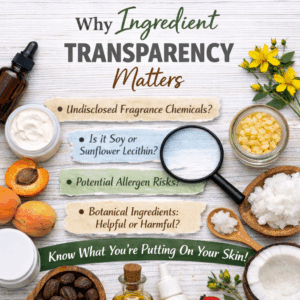
Healthy skincare isn’t about trends, celebrity routines, or miracle promises. It’s about understanding what you’re putting on your skin and how those ingredients interact with your biology. When it comes to face creams and other personal‑care products, ingredient transparency matters far more than marketing claims.
Last Updated: Mar 2026
The Limits of “Natural”
A common assumption in skincare is that “natural” automatically means gentle or universally safe. In reality, many natural ingredients are biologically active. Plant oils, botanical extracts, and essential oils can offer benefits for some people while causing irritation or inflammation for others.
This doesn’t make these ingredients inherently “bad.” It means context, concentration, and transparency matter, especially for products used daily on the face.1
The Importance of Quality Base Oils
I’m going to be blunt about something many people never see behind the scenes: good oils cost money. Formulators know this. When brands need to cut costs, one of the easiest places to do it is the base oils. Unfortunately, that can mean swapping in cheaper oils that aren’t ideal for facial skin, especially for sensitive or allergy‑prone people.
It’s also worth remembering that oils aren’t just “moisturizers.” Oils are chemistry. Their fatty‑acid profiles affect stability, shelf life, how they feel on the skin, and how they support (or disrupt) the skin barrier.1
(If you want the deeper background on fats and oils, here’s our longer breakdown: Understanding Oils & Fats for Health and Beauty.)
The Importance of Fatty‑Acid Balance
A well‑formulated face cream supports the skin’s natural lipid barrier. Oils rich in essential fatty acids can play a role in hydration, elasticity, and barrier integrity. However, not all oils are equally suited for facial skin, and stability matters.1
Some oils oxidize quickly or irritate reactive skin. Thoughtful formulation considers not just which oils are included, but how stable they are, how they’re processed, and how they interact with the rest of the formula.
Why Peanut Oil Is Problematic in Skincare
Peanut oil is a known concern in personal‑care products for two primary reasons: allergen risk and inflammatory potential. Peanuts are among the most common and well‑documented food allergens, and peanut allergy affects a meaningful portion of the population.10
While highly refined peanut oil may contain less allergenic protein than unrefined peanut oil, this is not something a consumer can safely assume from a label, especially when a product doesn’t specify the level of refinement or provide allergen‑related clarity. Research has also raised concern about exposure to peanut‑containing products on irritated or compromised skin as a potential sensitisation pathway (particularly in the context of atopic dermatitis and barrier disruption).11,12
In addition, peanut oil is rich in omega‑6 polyunsaturated fatty acids. Omega‑6 fats are essential in small amounts, but unbalanced exposure is associated with pro‑inflammatory signalling pathways in the body (including pathways involving arachidonic‑acid‑derived mediators).13,14 For these reasons, peanut oil is commonly avoided in formulations intended for sensitive or allergy‑prone skin.
Better‑Suited Oils and Structural Ingredients
When selecting oils and structural ingredients for facial skincare, stability, skin compatibility, and allergen awareness matter. Organic apricot kernel oil is often chosen for its light feel and skin‑conditioning profile. Organic jojoba oil is especially interesting because it’s technically a liquid wax ester rather than a typical triglyceride oil, which helps explain why it tends to be stable and skin‑compatible for many people.15
Beeswax plays an important structural role by helping seal in moisture and reduce transepidermal water loss while still feeling breathable when properly formulated.16 Organic coconut oil, when used thoughtfully and in balanced formulas, can provide barrier support and antimicrobial activity, but like many ingredients, it’s not “one size fits all,” and some skin types tolerate it better than others.
Evaluating Botanical Ingredients Carefully
Botanical ingredients are often touted as universally beneficial, but their biological activity can also make them problematic if they’re used carelessly or without full disclosure. St. John’s wort (Hypericum perforatum) is a good example: it contains compounds such as hypericin (and related constituents) that can increase photosensitivity, with evidence that topical exposure may cause photo‑irritation or phototoxicity depending on concentration and UV exposure.8,9
The issue is not that botanical ingredients are inherently harmful. The issue is that their effects are often complex, dose‑dependent, and highly individual, especially for reactive skin. Full ingredient transparency allows customers to make informed choices instead of being surprised later.
Rosehip Oil (A Botanical That’s Often a Great Fit)
On the positive side, some botanicals are popular for good reason. Rosehip is widely valued in skincare for being lightweight while still supportive of the skin barrier. It contains naturally occurring antioxidants and bioactive compounds (including carotenoids and polyphenols) that can support a more resilient‑looking complexion when properly sourced and stabilised.17,18
Fragrance vs. Essential Oils: Why the Difference Matters
Although both fragrance and essential oils are often used to scent products, they are not the same thing, and treating them as interchangeable does a disservice to consumers.
Fragrance (often listed as “fragrance” or “parfum”) can function as a trade‑secret mixture, meaning companies may not disclose the individual components of the blend. This is recognised in U.S. cosmetic‑labeling rules and FDA discussions of fragrance formulas and trade‑secret ingredients.2,3 In plain language, “fragrance” can hide a long list of chemicals a consumer never gets to see.4
If you haven’t read it yet, it’s broken down in detail here: 3,999 Ingredients Hide Behind The Word “Fragrance”.5
Essential oils, on the other hand, are identifiable plant‑derived substances with known chemical compositions. That doesn’t make them automatically safe for everyone. Essential oils are biologically active and can trigger irritation or allergic contact dermatitis in susceptible individuals, particularly when used at higher concentrations or on compromised skin.6,7 The key difference is this: fragrance is unknown by design, while essential oils are known but biologically active.
Essential Oils and Skin Sensitivity
Essential oils can provide antioxidant, antimicrobial, or soothing effects depending on the oil and the formulation. At the same time, dermatology literature documents that many essential oils can act as contact allergens or irritants, especially when oxidized, used too strongly, or applied repeatedly to sensitive skin.6,7
Different people’s skin reacts differently to the same ingredients, so there is no such thing as one perfect cream for everyone. That’s why ingredient lists should be complete and easy to access. So each person can evaluate whether a product is right for them.
Where the Ingredient Comes From Matters
Ingredient transparency isn’t just about what appears on a label, but where those ingredients come from. Take lecithin as an example. Lecithin can be derived from multiple sources, commonly soy or sunflower, yet labels often fail to specify which one is used. That matters for people with soy allergies or sensitivities, because “lecithin” without sourcing forces consumers to guess.
This same issue applies to many multifunctional ingredients that can be derived from multiple botanical or agricultural sources. Clear sourcing respects consumers and supports informed decision‑making.
Choosing Products With Confidence
When evaluating a face cream or personal‑care product, a few simple questions can cut through marketing noise:
- Are all ingredients fully disclosed and easy to find quickly?
- Is “fragrance” or “parfum” listed without any clarity?
- Are essential oils identified by name?
- Is there a long list of preservatives intended to maximise shelf stability?
- Is the formulation designed with sensitive skin in mind?
Transparency is about respect for the consumer. In the U.S., where cosmetic labelling has specific rules and specific gaps (including fragrance trade‑secret protections), the consumer’s best tool is still the ingredient list… when it’s complete and honest.2,3
Our Philosophy at Nature’s Complement
At Nature’s Complement, we believe skincare should be honest, transparent, and respectful of individual needs. Our formulations avoid undisclosed fragrance blends and clearly identify every ingredient used. We don’t use the vague label “fragrance.” When we use essential oils, they’re real essential oils, and they have a purpose in the product, not always just a scent.
Because when it comes to your skin, clarity matters.
Sincerely and for good health,
Rob for Nature’s Complement
References
-
- Elias PM. “Stratum corneum defensive functions: an integrated view.” Journal of Investigative Dermatology (2005).
https://pubmed.ncbi.nlm.nih.gov/16098026/ - FDA. “Cosmetics Labeling Guide” (includes ingredient declaration exemptions such as fragrance/flavor/trade‑secret ingredients).
https://www.fda.gov/cosmetics/cosmetics-labeling-regulations/cosmetics-labeling-guide - FDA. “Fragrances in Cosmetics” (trade‑secret discussion and fragrance formula complexity).
https://www.fda.gov/cosmetics/cosmetic-ingredients/fragrances-cosmetics - EWG. “3,163 ingredients hide behind the word ‘fragrance’.”
https://www.ewg.org/news-insights/news/3163-ingredients-hide-behind-word-fragrance - Nature’s Complement. “3,999 Ingredients Hide Behind The Word ‘Fragrance’.”
https://www.naturescomplement.com/2019/04/10/3999-ingredients-hide-behind-the-word-fragrance/ - de Groot AC. “Essential Oils, Part IV: Contact Allergy.” Dermatitis (2016).
https://pubmed.ncbi.nlm.nih.gov/27427818/ - Sindle A, et al. “Art of Prevention: Essential Oils—Natural Products Not Necessarily Safe.” (2020).
https://pmc.ncbi.nlm.nih.gov/articles/PMC8243157/ - Wölfle U, et al. “Topical Application of St. John’s Wort (Hypericum perforatum).” (2014).
https://d-nb.info/1185409394/34 - Onoue S, et al. “In vitro photochemical and phototoxicological characterization of St. John’s wort extract constituents.” (2011).
https://www.sciencedirect.com/science/article/abs/pii/S0031942211003086 - Boyce JA, et al. “Summary of the NIAID‑sponsored expert panel report” (peanut allergy prevalence estimate in U.S.). (2010).
https://www.jacionline.org/article/S0091-6749%2810%2901569-1/fulltext - Lack G, et al. “Factors Associated with the Development of Peanut Allergy in Childhood.” NEJM (2003).
https://www.nejm.org/doi/full/10.1056/NEJMoa013536 - Benor S, et al. “Epicutaneous exposure to peanut oil induces systemic allergic responses” (animal model; barrier disruption relevance). (2019).
https://pubmed.ncbi.nlm.nih.gov/30943491/ - Innes JK, Calder PC. “Omega‑6 fatty acids and inflammation.” (2018).
https://pubmed.ncbi.nlm.nih.gov/29610056/ - Patterson E, et al. “Health implications of high dietary omega‑6 polyunsaturated fatty acids.” (2012).
https://pmc.ncbi.nlm.nih.gov/articles/PMC3335257/ - Gad HA, et al. “Jojoba Oil: An updated comprehensive review on chemistry and biological activities.” (2021).
https://pmc.ncbi.nlm.nih.gov/articles/PMC8197201/ - Nong Y, et al. “A review of the use of beeswax in skincare.” (2023).
https://pubmed.ncbi.nlm.nih.gov/36999457/ - Medveckienė B, et al. “Carotenoids, Polyphenols, and Ascorbic Acid in Organic Rosehips.” (2020).
https://www.mdpi.com/2076-3417/10/15/5337 - Negrean OR, et al. “Recent advances and insights into the bioactive properties of rosehip.” (2024).
https://pmc.ncbi.nlm.nih.gov/articles/PMC11101839/
- Elias PM. “Stratum corneum defensive functions: an integrated view.” Journal of Investigative Dermatology (2005).
Nature's Complement is a participant in the Amazon Services LLC Associates Program, an affiliate advertising program. If you purchase products on Amazon through any of our affiliate links, we get a small percentage of the transaction, at no extra cost to you. We spend a lot of time writing the articles on this site, and all this information is provided free of charge. When you use our affiliate links, you support the writing you enjoy without necessarily buying our products. (However we would appreciate if you would do that too!) Thank you for helping to support our work, however you choose to do so.
These statements have not been evaluated by the Food and Drug Administration. This information and/or products are not intended to diagnose, treat, cure or prevent any disease.